China military researchers pinpoint AI for hypersonic weapons accuracy
- PLA scientists say artificial intelligence could write flight algorithm within seconds and be 10 times more accurate
- The system would need considerable computing power but ‘is feasible’ based on current technology
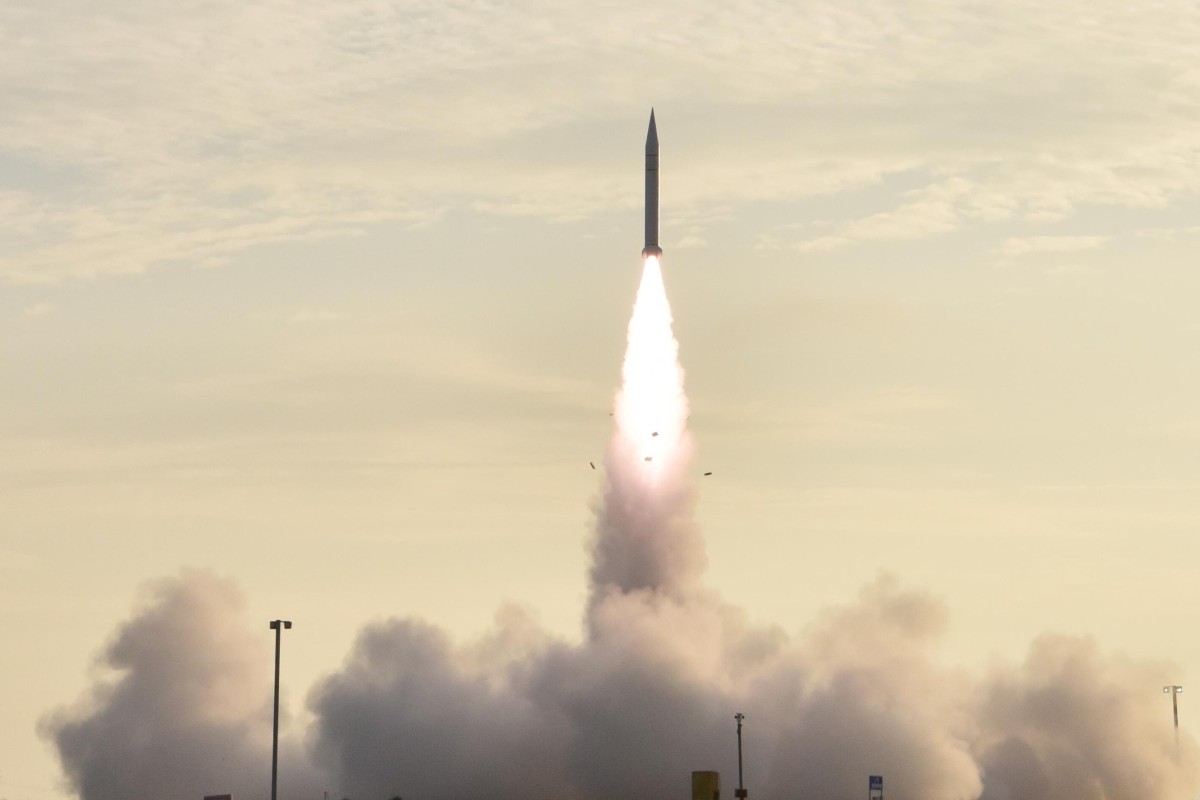
Professor Xian Yong and Li Bangjie, from Rocket Force Engineering University’s college of war support, said more decision-making power would be handed to the smart weapon – giving its human controllers no idea how it would behave after the launch button was pressed – but overall positioning accuracy “would increase by one to two orders of magnitude”.
Conventional missiles are equipped with positioning software which is installed and fine-tuned on the factory floor. But if the software was written by AI, with a different algorithm for each weapon, the researchers found they could address the challenges of controlling flight at five times the speed of sound or beyond.
Whether a hypersonic weapon can hit its target after travelling hundreds or thousands of kilometres depends heavily on how precisely it can determine its own position while making complex manoeuvres during flight.
At hypervelocity, parts of an aircraft can get hotter than the sun’s surface, breaking air molecules into electrically charged ions which form a plasma coating. This reduces the craft’s radar signature but can also make it blind and deaf – unable to pick up GPS signals or use other references, such as the Earth’s magnetic field, for guidance.
These extreme conditions over long distances have forced a reliance on built-in inertial sensors – such as quartz accelerometers and laser gyroscopes – which can only estimate a hypersonic weapon’s location. This is despite sophisticated control software and painstaking on-the-ground testing.
The researchers said physical disturbances to the sensors were inevitable during their assembly, transport and routine maintenance. And each time the weapon is powered up, it affects the hardware, causing further deviations from the factory settings.