Advertisement
Advertisement
China-Vatican relations
Get more with myNEWS
A personalised news feed of stories that matter to you
Learn more
A member of the crowd waves the flag of China as Pope Francis leaves following the weekly general audience at St Peter's Square earlier this month. Photo: AFP

Catholic Church accuses China of intimidating Vatican loyalists

  • Holy See’s request to stop pressuring those emerging from underground church is latest strain on historic deal with Beijing
  • Priests and bishops have to register with the state, but some fear the declaration they have to sign jeopardises their loyalty to the Pope

The Vatican asked Beijing on Friday to stop intimidating Catholic clergy who want to remain unequivocally loyal to the Pope and refuse to sign ambiguous official registration forms.

The request, contained in Vatican guidelines to clergy in mainland China, was the latest hiccup in relations between the Holy See and Beijing since the two sides signed a historic and disputed pact on the naming of bishops last September.

Under Chinese law, priests and bishops must register with the state. They also must sign a form accepting the principle of independence, autonomy and self-administration of the Church in China.

Some have refused, fearing that it could jeopardise their fidelity to the Pope as their religious leader and the independence of the local Church on doctrinal matters.
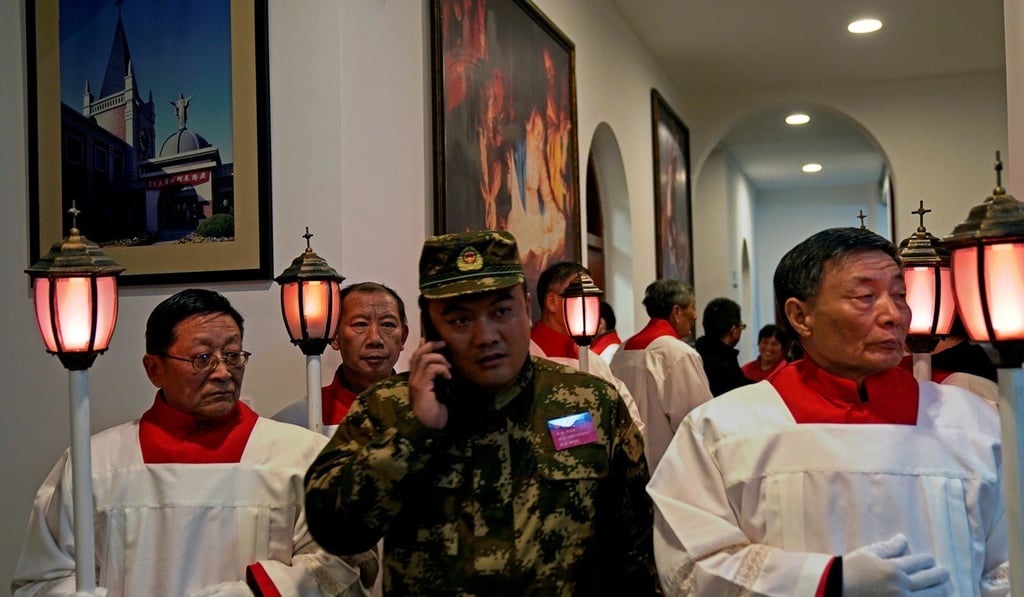
Chinese Catholics attend a mass in Shanghai. Photo: Reuters

Catholics in China are emerging from more than half a century of division which saw them split between a state-backed “official” Church and a “non-official” underground Church that remained loyal to Rome.

Some divisions have begun to dissipate slowly since the September agreement, which gives the Pope the final say in the appointment of bishops. But the registration process has caused difficulties for those emerging from the non-official Church.

In the guidelines, the Vatican called for a registration procedure “that is more respectful of Catholic doctrine, and thus of the consciences of those involved”.

It added: “The Holy See asks that no intimidatory pressures be applied to the ‘non official’ Catholic communities, as, unfortunately, has already happened.”

The guidelines, requested by some Chinese bishops, said clergy should demand to include a sentence affirming that Catholic doctrine would be respected.

Cardinal Joseph Zen has been an outspoken critic of the deal. Photo: Nora Tam

If authorities do not permit that, the priest or bishop, before signing, should take a stand orally before a government authority, preferably with a witness present.

September’s landmark deal between the Vatican and China has split Catholics there and around the world, with some critics of the Pope saying he has caved in to the Communist government.

The deal’s most outspoken critic has been Cardinal Joseph Zen Ze-kiun, the former archbishop of Hong Kong.

China’s constitution guarantees religious freedom, but since President Xi Jinping took office six years ago, the government has tightened restrictions on religions seen as a challenge to the authority of the ruling Communist Party.

China has been following a policy it calls the “Sinicisation” of religion, trying to root out foreign influences and enforce obedience to the Communist Party.

Post