China’s astronomers helped capture photo of black hole but couldn’t use world’s biggest telescope to do it
- Distance no object, but China’s Fast did not take part in cosmic event because it could not properly be tuned in to targets that lie light years away

On Wednesday, the world will see the first photo of a black hole, an image made possible because telescopes around the planet were joined in a two-year project to create a virtual radio antenna almost the size of the Earth itself, enabling astronomers to pick up faint signals from the far reaches of the universe.
None of the telescopes, however, is in China.
China has made great leaps in stargazing in recent years. The 500-metre aperture spherical telescope (Fast) in Pingtan, Guizhou province, is the largest single radio dish on the planet. In Miyun, Beijing, the Guoshoujing telescope can scan the night sky quicker than any competitor.
The reason China did not contribute hardware to the black hole imaging project, known as the Event Horizon Telescope (EHT), is that none of the country’s telescopes was built for the task, the Chinese astronomers involved in the project said.
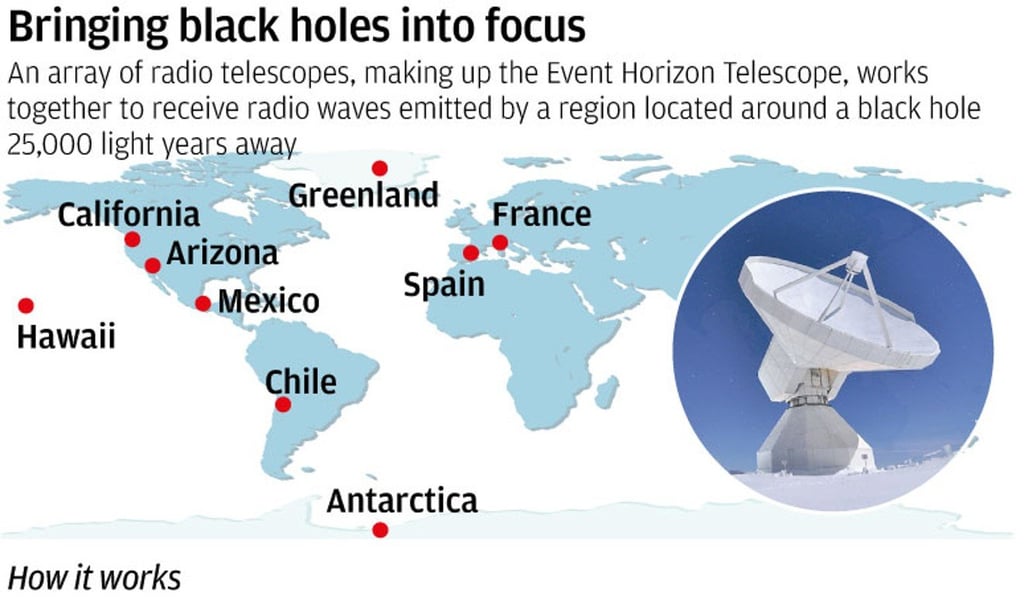
Black holes cannot be seen because their gravitational pull is so strong that light cannot escape. To draw a clear boundary of a black hole, astronomers turned their attention to light-emitting materials that were sucked into it. To detect these materials, especially those close to the black hole’s event horizon, where gravity is at its strongest, a telescope must be able to pick up very high frequency radio waves to produce a sharp image.