China turns on its ‘artificial sun’ in quest for nuclear fusion energy
- The HL-2M Tokamak apparatus is able to operate at 150 million degrees Celsius (270 million Fahrenheit), a temperature 10 times hotter than the sun
- Another milestone for China in its quest for clean energy through controlled nuclear fusion

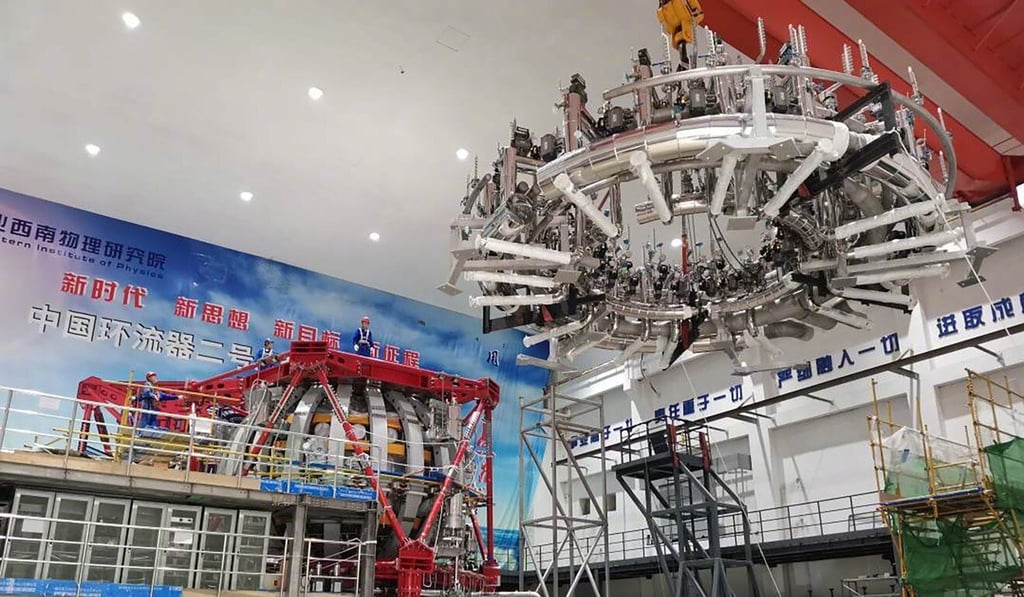
China on Friday made another step forward in its quest for clean energy through controlled nuclear fusion, as it commissioned its new “artificial sun” – a new generation nuclear fusion reactor research facility which operates at a temperature 10 times as hot as the sun.
According to China National Nuclear Corporation (CNNC), the HL-2M Tokamak apparatus is able to operate at 150 million degrees Celsius – almost three times hotter than the previous version called HL-2A.
The ability to generate such ultra-high temperature is essential for the research of fusion process, replicating the way the sun produces energy using hydrogen and deuterium gases as fuels. The sun only operates at a temperature of 15 million degrees Celsius.
The International Thermonuclear Experimental Reactor (ITER), which is under construction in southern France, is designed also to operate at up to 150 million degrees Celsius (270 million Fahrenheit).
The Korea Institute of Fusion Energy announced about a week ago that its reactor had succeeded in operating at 100 million degree Celsius for at least 20 seconds.
Yang Qingwei, chief engineer of CNNC’s Institute of Fusion Science at the Southwest Institute of Physics, was quoted by Xinhua on Friday as saying that HL-2M can achieve magnetic plasma confinement time of up to 10 seconds.