Chinese researchers aim to make a small splash for robots sent to mine the bottom of the ocean
- Robots are perfecting their diving skills in preparation for the serious business of tapping into mineral resources in the seabed
- One environmental protocol China proposes requires underwater drones to monitor mining robots and ensure no undersea environmental damage
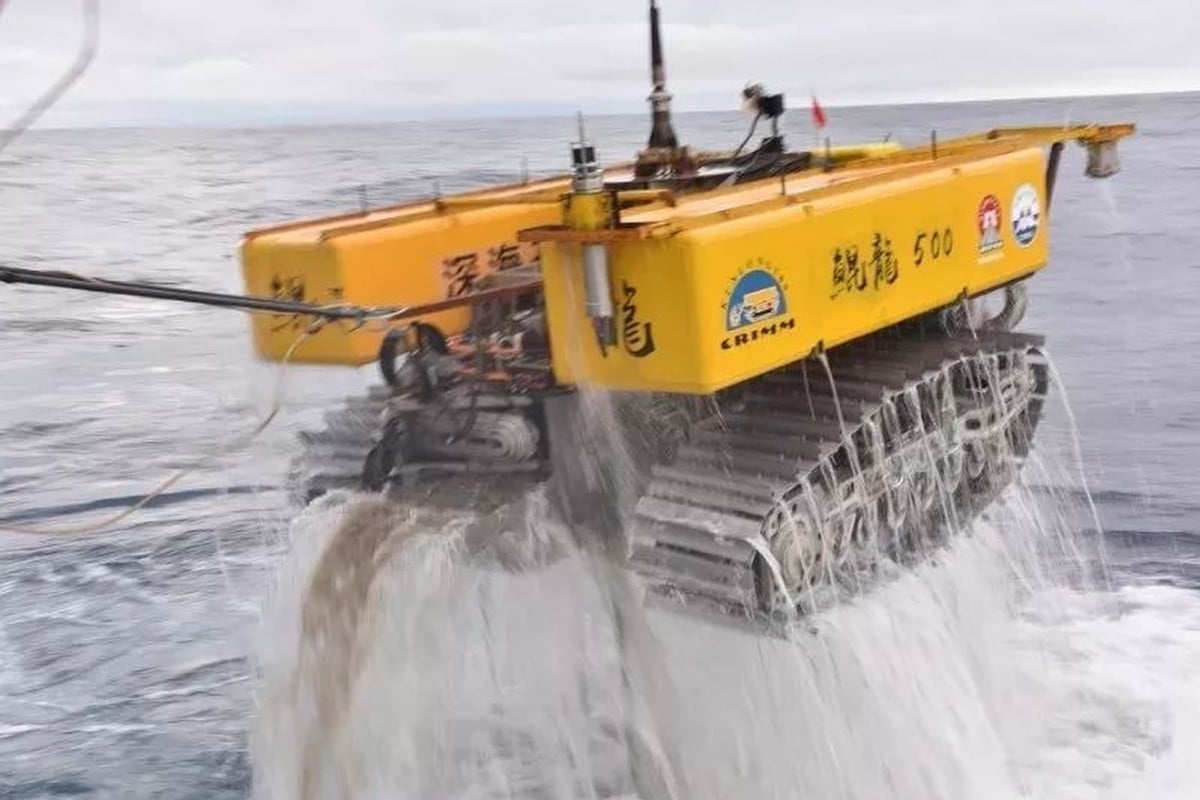
An increasing number of Chinese deep-sea mining robots have been dropped into the world’s ocean in recent years. As the test-run hours grew, scientists and engineers discovered issues that, if not resolved properly, could affect these machines’ long-term operation.
A typical deep-sea mining robot is about the shape and size of a bulldozer and built to withstand the enormous pressure on the sea floor, which is sometimes thousands of metres deep.
When the machine enters the water, a huge splash cannot be avoided.
“A splash looks harmless. But it can release an enormous amount of energy in a split second. There are many mechanical parts, electronic devices and tethering components in an autonomous mining machine.
“They may not always survive the shock, especially in bad weather or after repeated use. We need to bring the impact under control,” said Dai Yu, professor of mechanical and electrical engineering with Central South University in Changsha.
Computer simulations and laboratory experiments conducted by Dai’s team suggested the splashdown of a mining robot had a physical process like no other. To avoid damaging it, tactics should include a speed limit of about 2 metres (6.56 feet) per second, when entering the water.