Chinese scientists strike early gold in race to nuclear fusion power
- A project to replicate the sun’s energy process has shown promise after its first year of experiments, with a comparatively low-cost approach
- Lead researcher Zhang Zhe predicts a new generation of large-scale laser facilities will be finished or near completion in China by 2026

The cones, as small as pencil tips, have narrow ends which face each other and emit a plasma of hydrogen. When the two hot gas streams collide at precisely the right time and place, and in the right manner, they trigger a fusion reaction – the process which ultimately could provide a source of endless, sustainable energy.
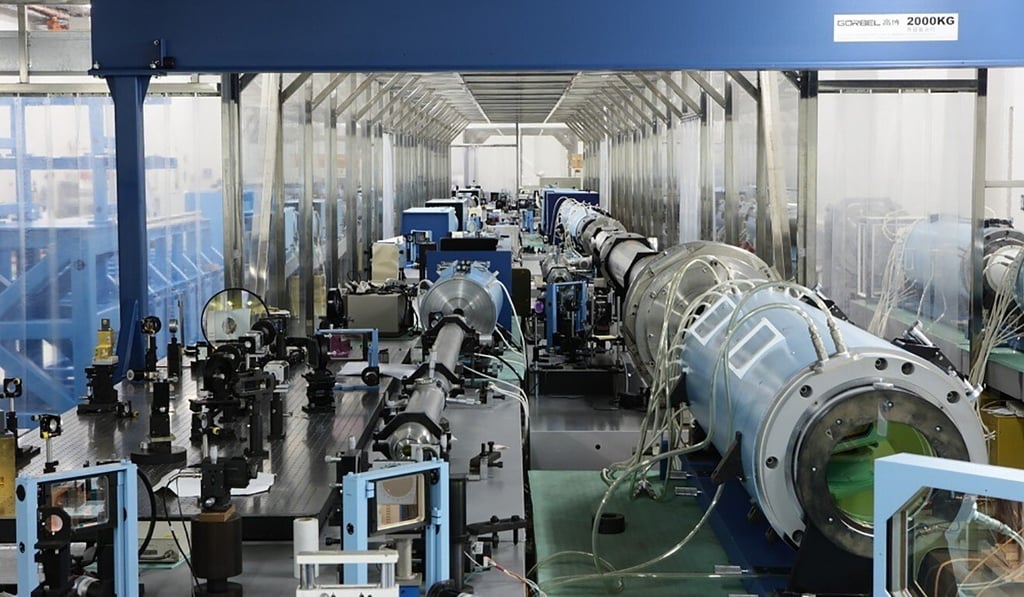
With government funding of 1 billion yuan (US$156 million) over six years, Zhang Zhe and his colleagues from the Chinese Academy of Sciences’ Institute of Physics in Beijing began their unprecedented experiments at the Shenguang II laser facility in Shanghai last summer.
The research team has conducted three tests so far, with another scheduled for next month, and encountered some unexpected challenges. But initial results suggest the theory works and part of the findings were published last week in domestic peer-reviewed journal Acta Physica Sinica.
“Our goal is to achieve sustainable fusion,” Zhang said in a phone interview on Tuesday. For power generation, “the cones can be mass-produced and loaded as bullets in a machine that will rotate and fire like a Gatling gun”.