China’s new radio telescope will have dangerous solar eruptions in its gaze
- Work on what will be the world’s largest circular array for solar radio imaging is expected to be finished by the end of the year, supervisor says
- It is being built on the Tibetan Plateau in Sichuan province and will be used alongside another solar telescope being assembled in Inner Mongolia

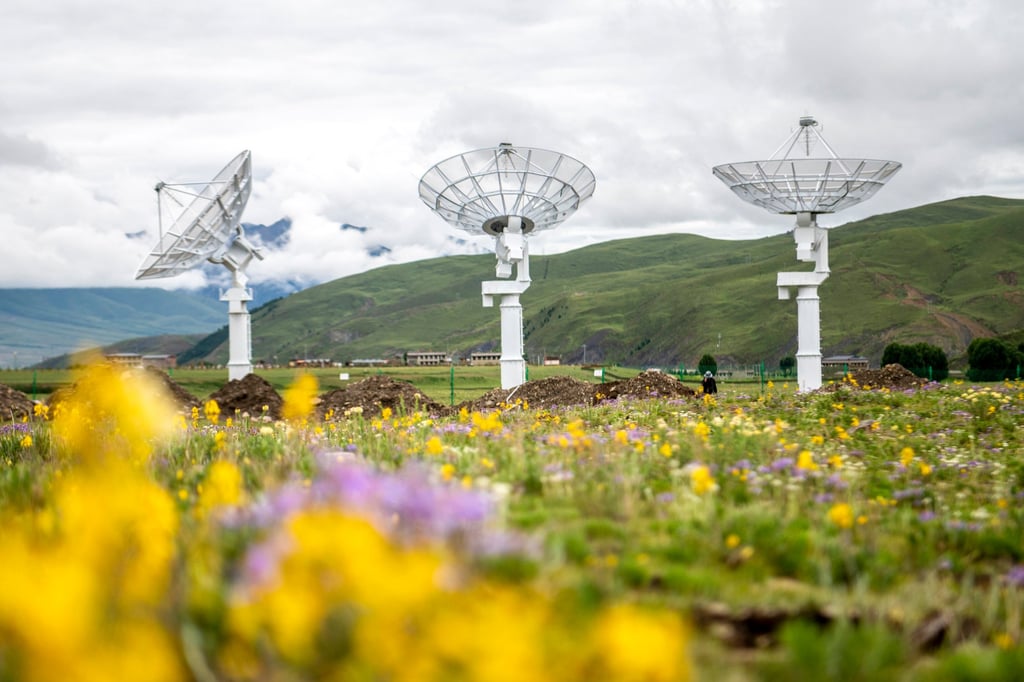
Construction of the world’s largest circular radio telescope array aimed at the sun – located in southwest China – is expected to be finished by the end of the year, according to the project’s supervisor.
The Daocheng Solar Radio Telescope (DSRT) is being built at a site high up on the Tibetan Plateau and will have 313 dishes, each of them 6 metres (19.7 feet) across.
It will be used to study dangerous solar eruptions known as coronal mass ejections – when magnetised plasma escapes from the sun’s upper atmosphere and propagates in the interplanetary space.
These eruptions are believed to have caused major geomagnetic storms on Earth, including the Carrington Event in 1859 during which telegraph stations all over Europe and North America failed.
There is a key difference in how they will work. The Mingantu telescope aims to monitor the sun in an indirect way, by detecting how radio signals from deep space are scattered by solar winds. But the DSRT will take direct images of the sun in radio waves with a frequency range between 150 and 450 megahertz.