China plans to view the universe’s dark past using a fleet of telescopes orbiting the moon
- The Discovering the Sky at the Longest Wavelength mission, also called Hongmeng, involves ‘mother and daughter satellites’ observing ancient hydrogen atoms
- The biggest challenge will be to filter out unwanted radio signals from the universe
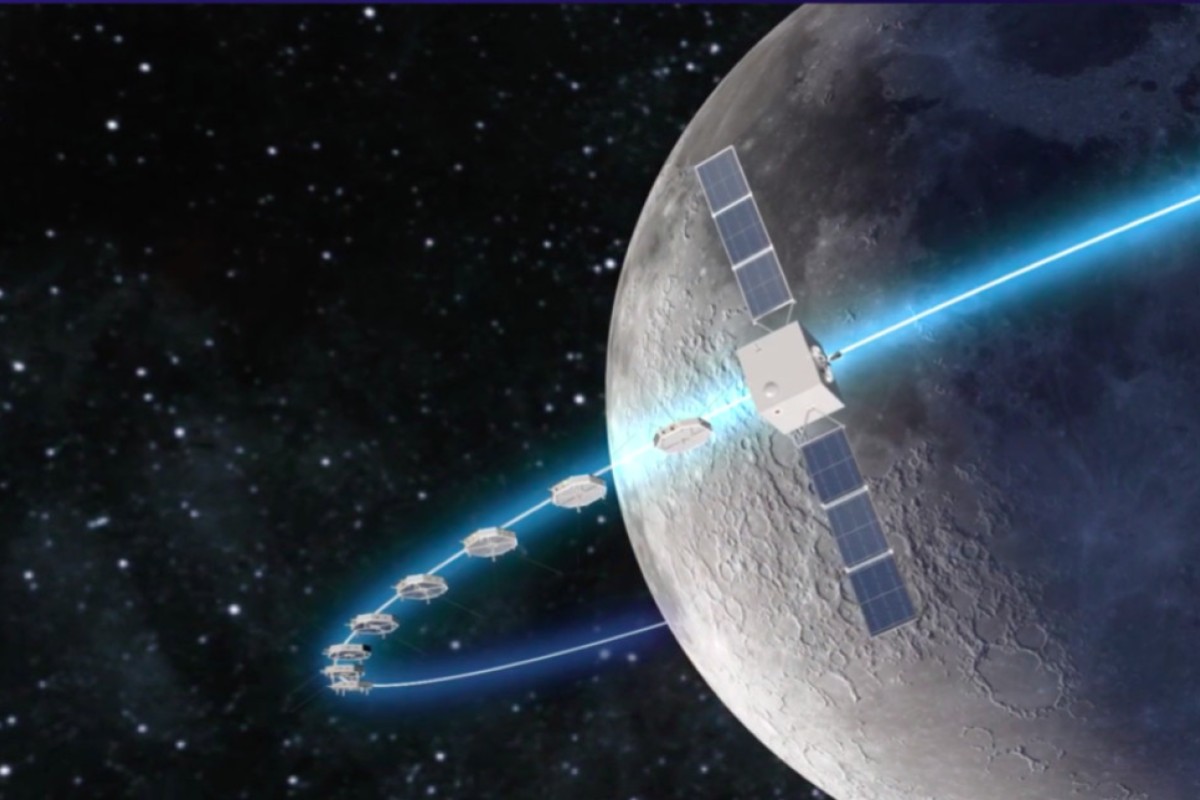
A team of Chinese scientists have proposed sending a fleet of telescopes to orbit the moon and peek into the most mysterious era of the universe’s past.
The Discovering the Sky at the Longest Wavelength (DSL) mission, if officially approved in the coming weeks, would shed light on the so-called cosmic dark ages, a time when the infant universe was nothing but a sea of darkness.
Astronomers believe the first stars appeared when the universe was about 200 million years old. Before that, the world was a rather obscure and empty place: no suns, no planets – only the hydrogen atoms forged from the Big Bang.

01:28
Nasa offers deepest-ever look in space, the farthest humanity has ever seen in time and distance
Those ancient hydrogen atoms hold the key to the dark era and the structure of the universe we live in today, but are impossible to detect from Earth because of interference from human radio activities, said project scientist Chen Xuelei, of the National Astronomical Observatories in Beijing.
The proposed mission by Chen and his team – also dubbed Hongmeng, after “the grand mist of the primordial universe” in Chinese mythology – involves a linear array of nine so-called daughter satellites, each carrying a radio receiver to observe the hydrogen atoms from the far side of the lunar orbit, and a mother satellite to collect and send observation data back to Earth when the fleet is at the near side.
Scientists have long thought about using the moon as a shield against earthly noises to study the early universe, but discussions were focused on building telescope dishes or arrays on the surface of the far side of the moon, Chen said.
Those schemes are expensive to implement and involve technical complications related to landing and construction on the moon’s far side, according to Wu Ji, former director of the National Space Science Centre who helped the project take shape but is no longer involved in its development.