Chinese tech firm launches GPU chip it claims marks ‘new era’ for computing
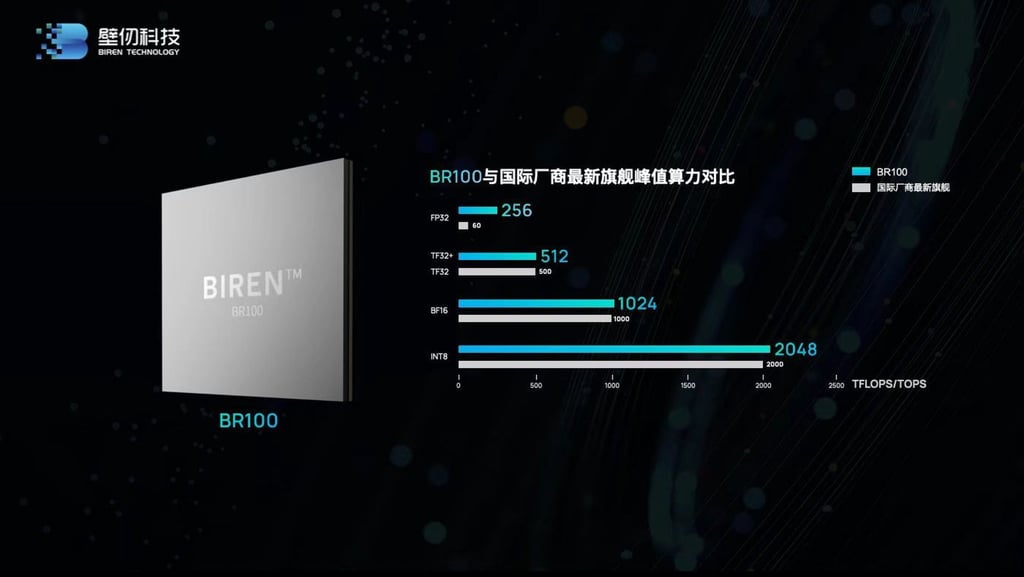
- Biren Technology says the peak performance of its 7-nanometre chip – made by TSMC – is three times better than equivalent products on the market
- It will be used in large-scale, cloud-based AI training in data centres and the company aims to partner with firms such as server provider Inspur
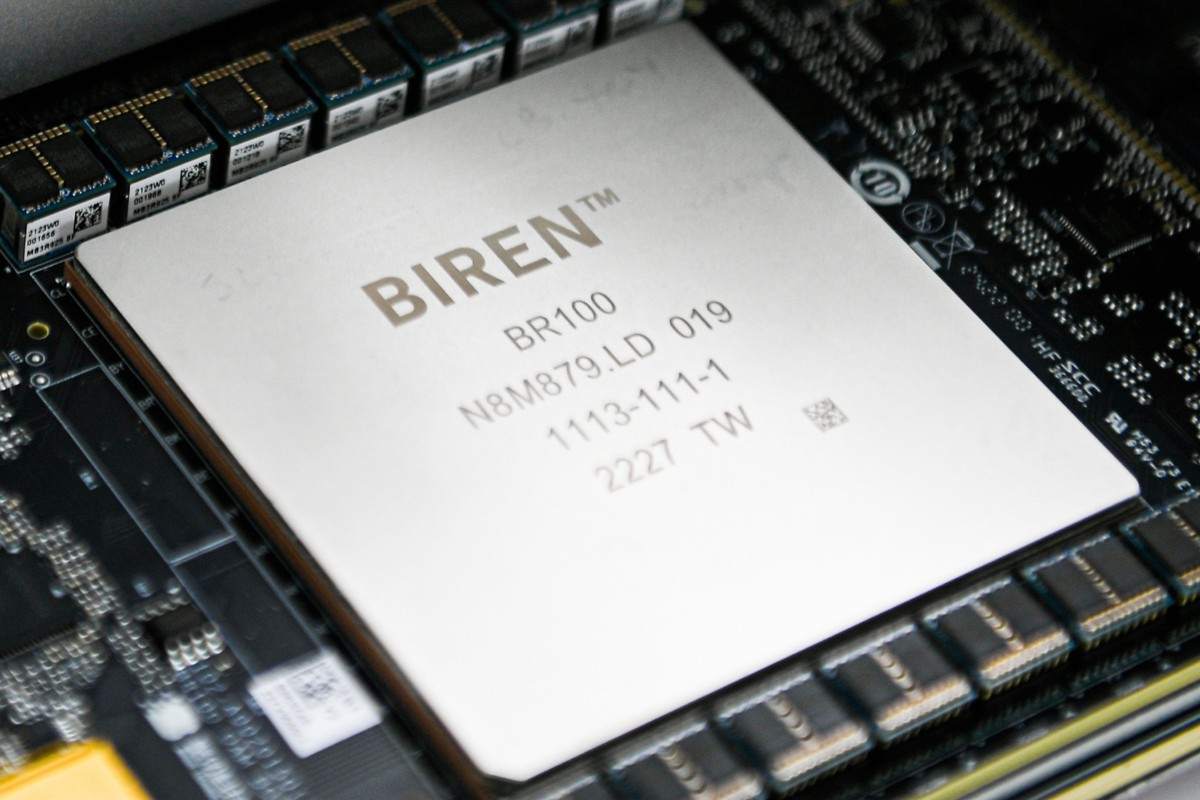
Biren Technology said in a statement that the peak performance of its BR100 chip, which was launched on Tuesday, was three times better than equivalent products on the market.
“This marks a new era, with China’s GPU chips being capable of performing 1 quadrillion floating-point operations per second [petaFLOPS or PFLOPS],” Zhang Wen, chief executive of Biren Technology in Shanghai, said in a statement.
GPUs are designed for more intensive computation than CPUs, or central processing units. They do this through parallel processing – using multiple processors for the task. Biren’s new chip is what is known as a general-purpose GPU, meaning it is not just for graphics in consumer electronics but for broader computation.
Speaking at the launch event in Shanghai, industry expert Professor Wang Yu said all chip makers would benefit if a “unified ecosystem” could be established that allowed more users to program and build their own applications. Wang heads Tsinghua University’s electronic engineering department and was not involved in the BR100.
Chinese start-ups Innosilicon, Iluvatar CoreX and Moore Threads have also released their first GPGPU products in recent months, but most are not yet commercially available in mass production.