Chinese scientists say their new ‘shivering muscle’ converts sunlight to mechanical energy
- Team devised an artificial ‘muscle’ from porous polypropylene film and carbon black that powered a machine through movement, paper reports
- Lead researcher says potential applications include running microsensors and smart robots

Chinese researchers have developed an artificial muscle from a new material that “shivers” under the sun to directly convert solar energy to rapid mechanical movements.
The team behind the invention said it used these spasms, which resembled heartbeats, to drive a machine.
The scientists, including researchers from Nankai University and China Pharmaceutical University, published their findings in the peer-reviewed journal Nature Communication on September 24.
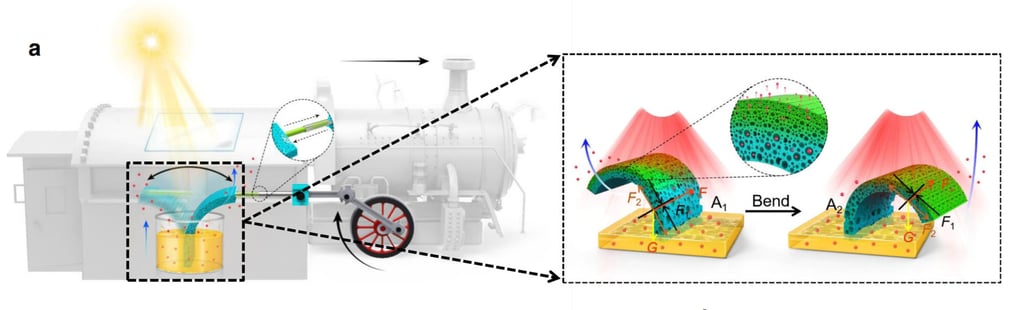
“It is the first time scientists have directly converted solar energy to continuous mechanical work. This solar engine could be used in microsensors or smart robots,” leading researcher Liu Zunfeng, of Nankai University’s college of chemistry, said.
The muscle is made of a porous polypropylene film mixed with carbon black, a crystal-like carbon material that absorbs heat. Its porosity gives the film excellent ability to spontaneously draw up liquid via a capillary action. As a result of the liquid’s movement, the film stretches when soaked with a solvent such as ethanol, and shrinks as the solvent evaporates due to heating.
Scientists placed an upright piece of film in a pool of ethanol and put the device under sunlight. The film shivered on its own and moved back and forth like pistons in an engine.
The evaporation of the solvent occurred on both sides, with the side under sunlight evaporating solvent faster than the side in the shade. As a result, the alternating volume decreases moved the film.