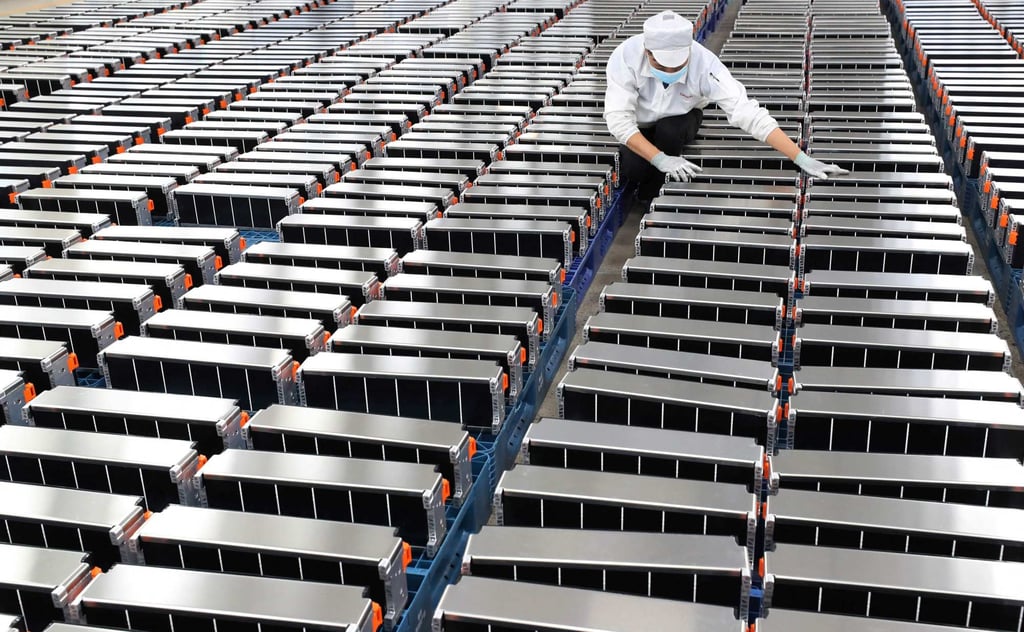
China’s submarine fleet may soon be powered by lithium batteries
- Technical solutions have been found through extensive development and testing in booming electric car market, according to navy study
- Researchers say that replacing problematic lead-acid batteries with lithium could significantly boost subs’ survival and combat abilities

A lithium power source – instead of lead-acid batteries – could more than double the time a submarine can spend under water, give it Tesla-style acceleration and create more room for weapons, said researchers with the Naval Submarine Academy in Qingdao, Shandong province.
The changes could significantly boost a submarine’s survival and combat abilities, they said in a paper published in peer-reviewed Chinese journal Marine Electric and Electronic Engineering on October 15.
The navy had concerns about replacing batteries in the submarine fleet with lithium ones, in particular that they could catch fire or explode. But according to the study, technical solutions have been found through extensive development and testing in China’s electric car market – and lithium batteries have been shown to work safely in challenging situations.
“After solving these problems, the replacement of lead-acid batteries with lithium batteries in conventional submarines is just around the corner,” said the team led by Wang Feng, a submarine designer at the academy.
China has the world’s largest conventional submarine fleet, with an estimated 60 to 70 vessels.
Conventional submarines use diesel engines on the surface, but when submerged the propulsion system and other equipment draw power from a battery. In battery mode, they make less noise than a nuclear submarine that must use large, powerful pumps to cool the reactor. All US Navy submarines are nuclear-powered and there have reportedly been cases of modern conventional subs going undetected until they were dangerously close.