Advertisement

Could this Chinese-developed ‘chiller’ change the way we cool our buildings?

  • Multi-layer chiller could significantly cut the amount of energy required to keep buildings cool during warmer months
  • Integrated radiative and evaporative chiller also shows promise in keeping the human body cool outdoors

Reading Time:2 minutes
Why you can trust SCMP
6
A multi-layer chiller developed by Chinese researchers could significantly cut the amount of energy required to keep buildings cool during summer. Photo: CFOTO/Future Publishing via Getty

Researchers from Tsinghua University in China have developed a new cooling technology that they say could be used to reduce human body heat or cool industrial facilities, data centres and other buildings.

Building cooling – like air conditioning and refrigeration systems – accounts for about 10 per cent of global electricity consumption.

As the planet warms and living standards improve, global energy demand from air conditioners is expected to triple by 2050 from 2018 levels, according to an International Energy Agency report.

01:40

‘Climate time bomb ticking’: UN chief says carbon emissions must be urgently cut

‘Climate time bomb ticking’: UN chief says carbon emissions must be urgently cut
But operating more air conditioning systems, which are considered large emitters of greenhouse gases, will worsen global warming, according to scientists who have been searching for cleaner, more effective cooling methods.
Advertisement

To help solve the problem, researchers from Tsinghua University have designed a multilayer material that can conduct evaporative and radiative cooling at the same time. Their study was published earlier this month in Nano Research Energy, a peer-reviewed journal published by Tsinghua University.

The “integrated radiative and evaporative chiller” (IREC) uses a material that combines a water-soluble hydrogel layer with an upper layer of breathable fibres to reflect light.
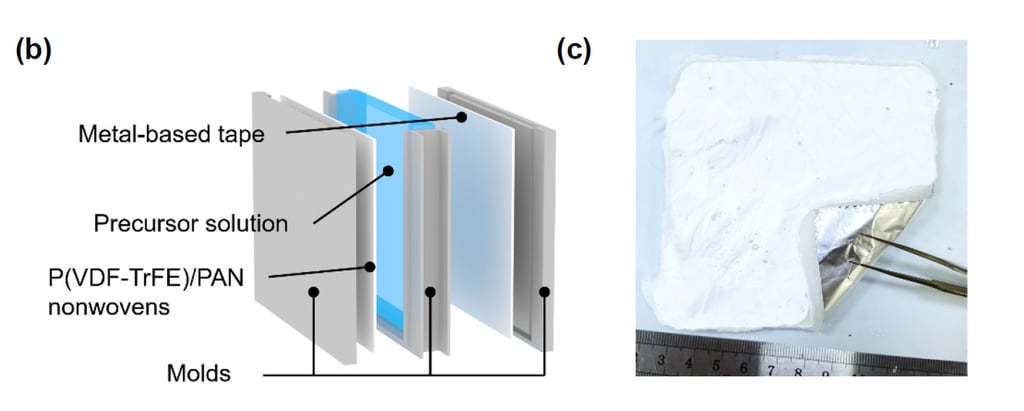
Tsinghua University researchers have developed the integrated radiative and evaporative chiller to help keep buildings and people cool. Photo: Tsinghua University

In experiments, the device achieved a record for practical average daytime cooling at 710 watts per square metre – several times that of a single radiative cooling process, according to the authors.

Advertisement
Advertisement
Select Voice
Choose your listening speed
Get through articles 2x faster
1.25x
250 WPM
Slow
Average
Fast
1.25x