-
Advertisement
Science
ChinaScience

Ancient Chinese relics point to unbroken cultural links that began a million years ago

  • ‘Powerful’ new evidence connects hominin activity to rise of Chinese culture
  • ‘Complete evolutionary chain of ancient humans in China’ has been established, archaeologist says

Reading Time:3 minutes
Why you can trust SCMP
6
Artefacts uncovered at the Yeyuan site are rewriting China’s pre-history. Photo: Shaanxi Provincial Cultural Relics Bureau
Stephen Chenin Beijing

The earliest signs of civilisation in China have been dated to thousands of years ago, with many ancient cultural and political traditions still in place today. But emerging evidence has helped researchers establish a much longer continuity between early hominin activity and the roots of Chinese civilisation.

A series of excavations carried out between 2019 and 2023 at various locations in the Yellow River Basin – considered the birthplace of Chinese civilisation – have yielded stone tools and other artefacts that date from between 1.1 million to 10,000 years ago, according to scientists.

“The uninterrupted history of hominin development in our country can be dated back over a million years,” said Luo Wenli, director of the Shaanxi Provincial Cultural Relics Bureau, in a report posted online by People’s Daily. Hominins consist of all modern and extinct humans and our immediate ancestors.

00:57

600-year-old statues revealed as China’s Yangtze river dips to lowest level in 150 years

600-year-old statues revealed as China’s Yangtze river dips to lowest level in 150 years
The artefacts uncovered include hand axes, choppers and other tools, likely used for hunting, among activities. Scientific analysis of the relics suggests there was a continuous development of prehistoric culture in the region over a long period, according to Luo.
Advertisement

Among the excavations, the deepest continuous cultural deposit measured 24 metres (78 feet). Tens of thousands of artefacts have been unearthed at more than 150 sites.

“They offer a powerful piece of evidence,” Luo said.
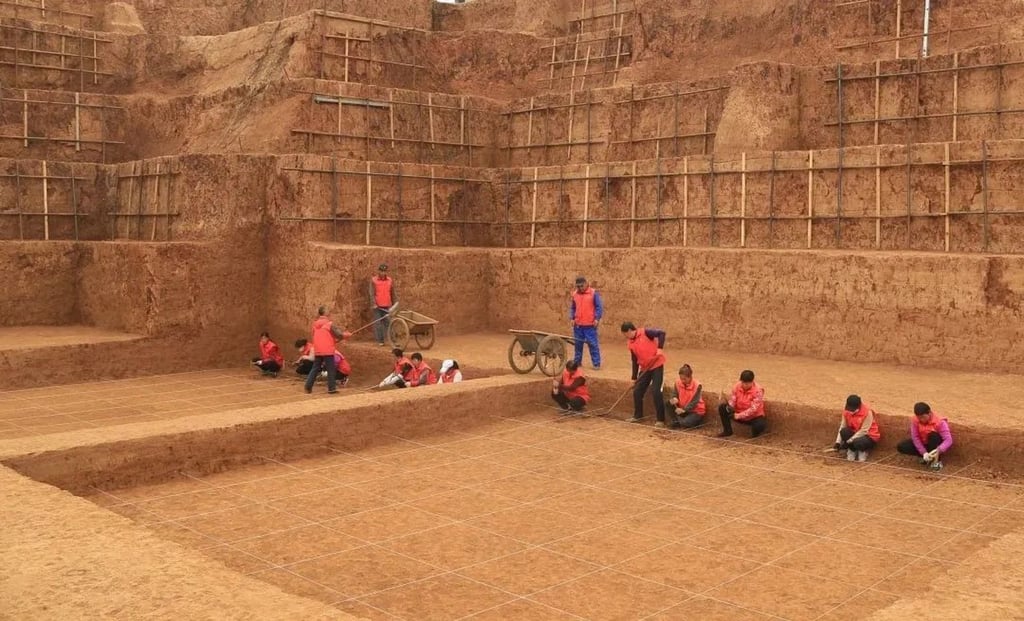
The prehistoric Yeyuan site, in the Nanluo River valley in China’s Shaanxi province, has 36 layers of sediment, stretching back more than a million years. Photo: Shaanxi Provincial Cultural Relics Bureau
The traditional theory of “out of Africa” suggests that modern humans evolved in Africa and then migrated out of the continent. The idea is that humans arrived in southern China around 60,000 years ago and spread across the region, replacing other hominin populations that they encountered along the way.
Advertisement
Advertisement
Select Voice
Select Speed
1.00x