Lift-off for Lingxi-03: China tests ultra-thin flexible solar wing for satellite network to rival Elon Musk’s Starlink
- The Lingxi-03 and its bendable solar panels are developed by the Beijing-based start-up GalaxySpace
- The communications satellite has an open-frame design with all instruments attached to the exterior and exposed to harsh space environment

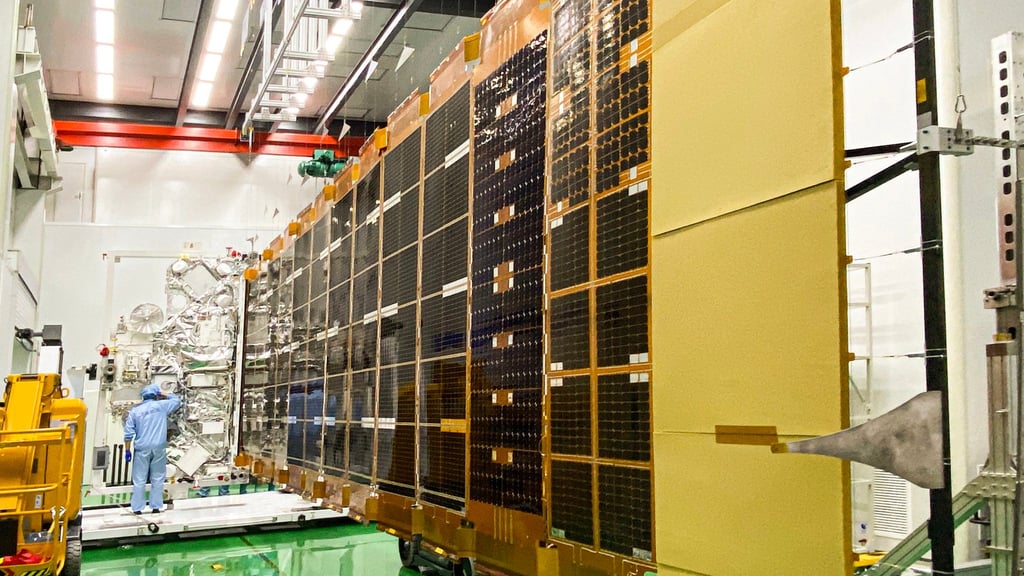
The Lingxi-03’s bendable solar panel measures about 1mm thick – similar to a credit card and only 5 per cent of the thickness of a traditional solar panel – according to state broadcaster CCTV. When folded inside a rocket, the solar array is 5cm (2 inches) thick, and it expands to 9 metres long and 2.5 metres wide (29.5 feet by 8.2 feet) once operational in orbit.
“These solar wings are small, lightweight and easy to store. They absorb more solar energy than traditional solar panels do and are especially suitable for large-scale stackable satellite launches,” Zhu Zhengxian, chief technology officer of GalaxySpace, told China Science Daily on Tuesday.
The Lingxi-03 is also China’s first satellite with an integrated main body structure, according to Zhu. He said the satellite platform was inspired by the chassis of a car and used advanced die-cast technologies, making it suited to mass production.
The Lingxi-03 is equipped with a digital payload that can handle tens of gigabytes of data per second, and will verify technologies related to next-generation low-orbit broadband communications, active thermal control and stackable satellite release, among others, the satellite’s chief commander Hu Zhao told CCTV.