Chinese-led team reveals secrets of giant star’s explosive death after boost from citizen scientists
- ‘The death of a massive star can be much more complex than previously thought,’ lead author says
- Non-professional astronomers may be more flexible to capture new objects of interest than professional experts, says biologist turned amateur stargazer

For the first time, a China-led team has revealed images of the immediate aftermath of a giant star’s explosive death, challenging the standard theory of stellar evolution.
Using professional and amateur telescopes based in China, the United States, Europe and Russia, the researchers were surprised to find that the star – some 85 million times the size of the sun in the Pinwheel galaxy – was surrounded by thick layers of dust as it ran out of fuel and blew up.
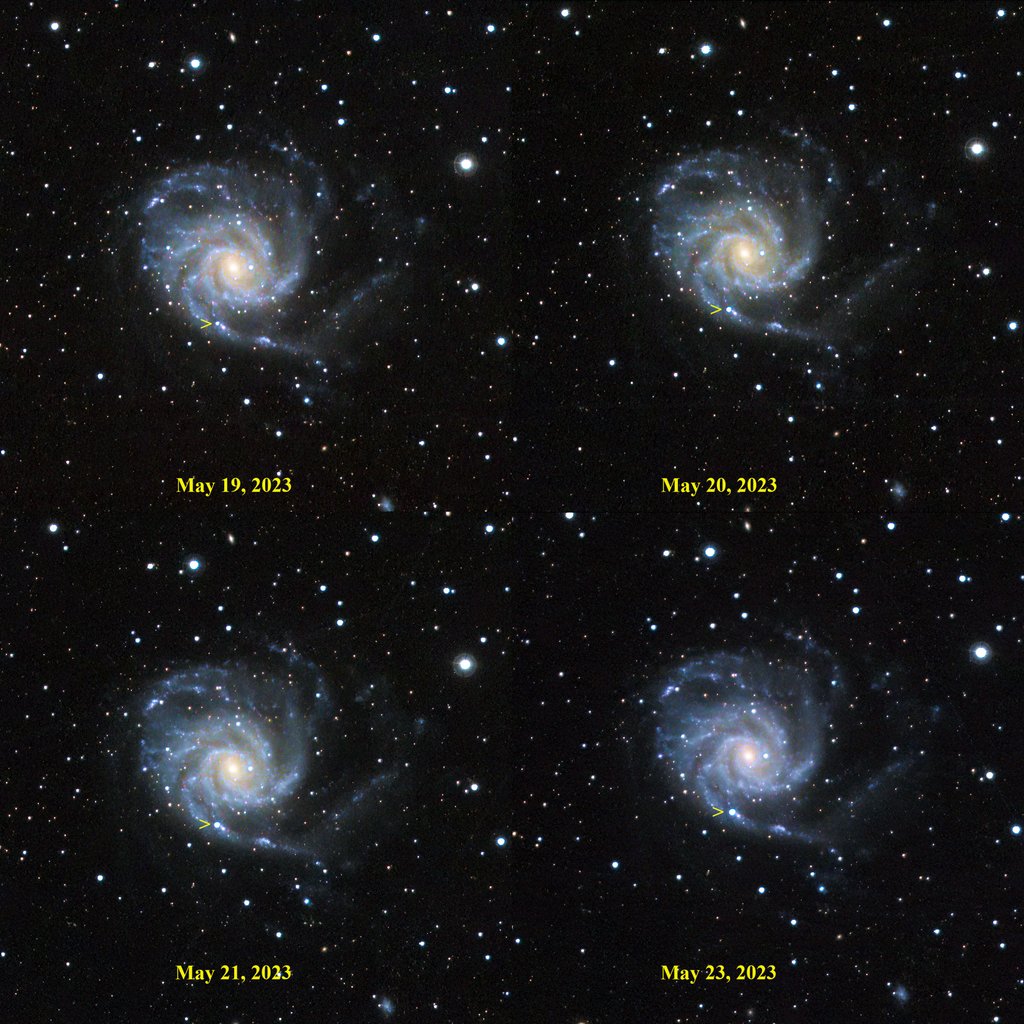
This “veil of death”, which was formed using materials expelled by the star during its final years of life, prevented the explosion’s shock wave from quickly breaking out into open space, they reported in the journal Nature on December 13.
“While the shock wave was expected to be very hot and short lived, our study showed that it was not the case within the first hours the star went supernova,” said the paper’s lead author Wang Xiaofeng from Tsinghua University in Beijing.
“It showed that the death of a massive star can be much more complex than previously thought.”

04:00
China launches 12th manned space mission with Shenzhou 17 crew en route to Tiangong space station
Scientists have relatively well-matched theories and observations of how stars of small or medium mass live and die, according to Wang. However, the evolution mechanism of massive stars, which by definition have eight or more times the mass of the sun, remains unclear.