Chinese scientists create world’s fastest vision chip for autonomous cars, defence
- Tsinghua University team says their Tianmouc ‘perception chip’ has record-breaking image processing speed
- Inspired by the brain, it analyses visual information along two pathways: one for cognition, one for rapid response

The team from Tsinghua University in Beijing say their chip, Tianmouc, has a record-breaking image processing speed. They said it had achieved high-speed sensing of up to 10,000 frames per second, a dynamic range of 130 decibels, and excellent spatial resolution.
Data flow is reduced by 90 per cent compared with traditional high-speed imaging chips and power consumption is low.
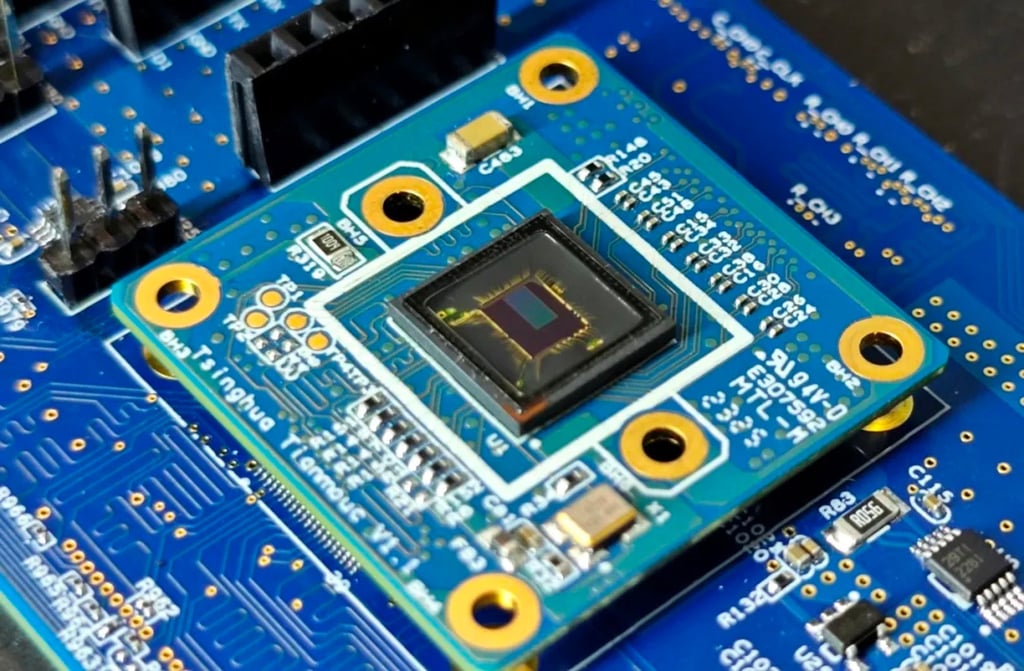
“This is a perception chip, not a computational one, based on our original technical route,” project leader Shi Luping, a professor with the university’s Centre for Brain-Inspired Computing Research, said in a statement on Tsinghua’s website on Thursday.
“Firstly, it balances speed and dynamic performance in vision chips and introduces a novel computational method that diverges from existing machine vision strategies,” Shi said.
“Secondly, this approach mimics the human visual system’s dual pathway, enabling decision-making without complete clarity,” he said.
“The chip provides new directions for advancements in autonomous driving and defence sectors. It is poised to tackle some of the most challenging issues faced today, paving the way for numerous novel applications.”
The team reported on the development in the journal Nature on Thursday, with Shi and Professor Zhao Rong the corresponding authors of the study.