‘Significant potential’: China uses organic ‘detector’ to extract ocean uranium for energy
- ‘Exceptional’ new material could be the answer in search for an efficient, economical source of endless nuclear energy, researchers say

The research group at the Qingdao Institute of Bioenergy and Bioprocess Technology (QIBEBT) under the Chinese Academy of Sciences has delivered a new “cost-effective” material that they said has “exceptional uranium adsorption capability”.
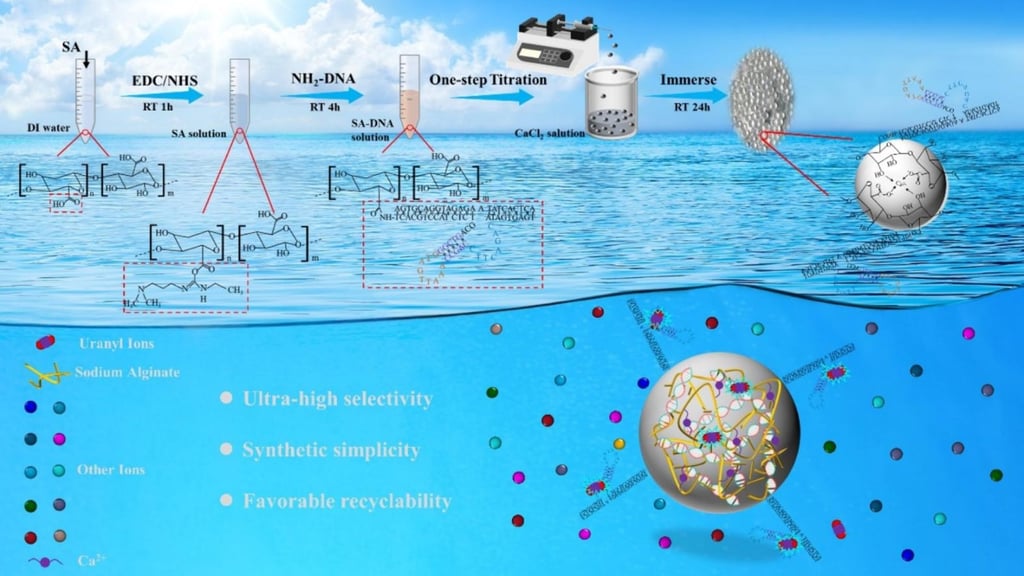
Adsorbent materials work by allowing a dissolved solid, gas or liquid to adhere to their surfaces. The Chinese-developed material consists of very small, hollow, round particles known as “SA-DNA hydrogel microspheres” with organic structures that are about 2mm across and contain numerous micrometre-sized pores.
The material was created by combining sodium alginate – a readily available product extracted from kelp or other sources – with functional strands of DNA that can recognise and bind to uranium ions.
The team, led by QIBEBT engineer Fa Yun and researcher Liu Huizhou, published their findings in the peer-reviewed Chemical Engineering Journal this month.