China completes key Lanyue lander test in preparation for crewed moon mission by 2030
Test marks ‘a major milestone’ in lunar landing effort, space agency says

A prototype of the four-legged Lanyue lander – designed to ferry two astronauts between lunar orbit and the surface – underwent a comprehensive trial on Wednesday in Huailai county, in northern China’s Hebei province, the China Manned Space Agency (CMSA) announced on Thursday.
Using giant tether towers to mimic lunar gravity and a cratered field to simulate the moon’s rugged terrain, the test was designed to see how well the Lanyue’s systems work together, from its landing and ascent design to the control system, engine shutdown on touchdown, and coordination among guidance, navigation and propulsion systems.
“This marks a major milestone in China’s effort to develop a crewed lunar landing mission,” the space agency said, adding it was also the country’s first full test of a crewed spacecraft’s potential ability to land on, and take off from, an extraterrestrial body.
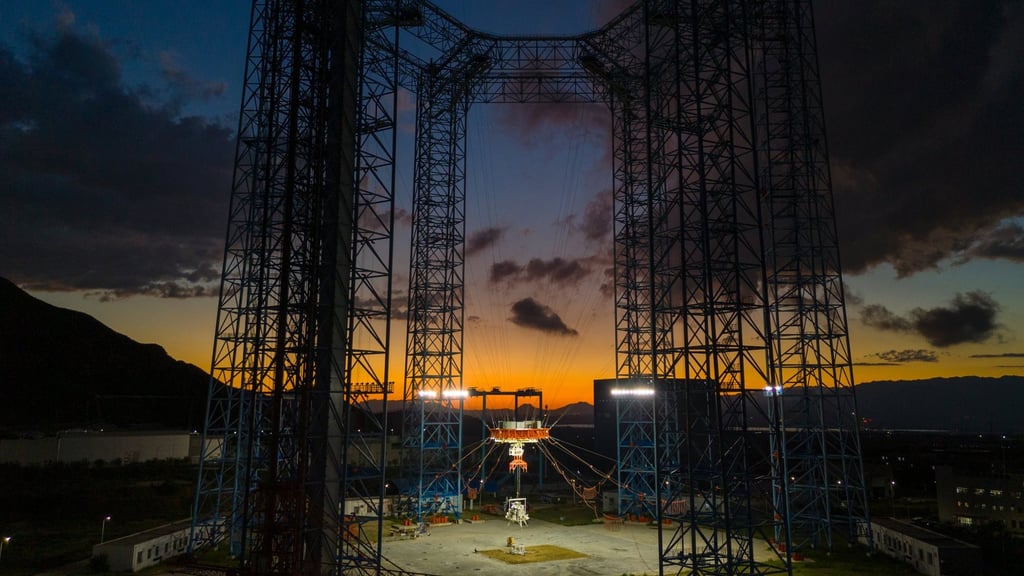
Footage aired by state broadcaster CCTV showed a lunar rover mounted on the lander’s side, along with a ladder attached to one leg for astronauts to climb down to the surface. During the descent, main engines and attitude-control thrusters emitted yellowish exhaust – likely nitrogen dioxide from the propellant.
The Lanyue would serve as astronauts’ shelter, power source, and data hub during their stay on the moon, the CMSA said. Given its many functions, the lander was especially challenging to design, Huang Zhen, of the China Aerospace Science and Technology Corporation, said.