Advertisement
How China is working to turn Saishiteng Mountain into the world’s largest astronomy base
Telescopes at the remote site are set to surpass Hawaii’s Mauna Kea in light-gathering power by the mid-2030s, scientists say
2-MIN READ2-MIN
42
Listen

Ling Xinin Beijing
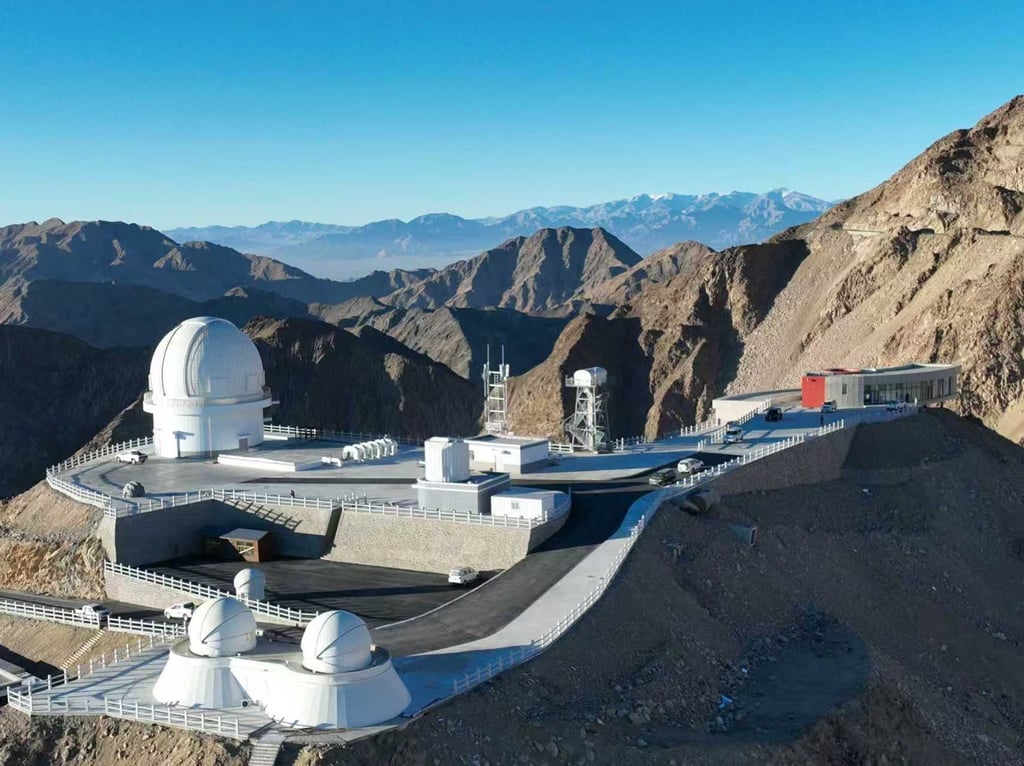
Construction on the Tibetan plateau of some of the Earth’s most powerful optical telescopes is putting China on track to house the world’s biggest astronomy base by the mid-2030s, according to project scientists.
Deng Licai, lead scientist for site planning at the National Astronomical Observatories of China (NAOC) in Beijing, said the telescopes at Saishiteng Mountain in northwestern Qinghai province would stretch between 6.5 metres (21.3 feet) and 14.5 metres across, and partner with dozens of smaller instruments.
“Their collective light-gathering power is expected to surpass [that of the telescopes] on Hawaii’s Mauna Kea peak,” he said on Wednesday.
Mauna Kea has long been regarded as the crown jewel of ground-based astronomical observation, home to the twin 10-metre Keck telescopes, the 8.2-metre Subaru and the 8.1-metre Gemini North.
Groundwork, mirror polishing and instrument development were already under way for the 2.5 billion yuan (US$369.03 million), 14.5-metre Large Optical Telescope (LOT) and the 1.5 billion yuan, 6.5-metre MUltiplexed Survey Telescope (MUST), Deng said.
LOT is government-funded and led by the NAOC, while MUST is backed mainly by private capital and led by a team from Tsinghua University. Both aim to achieve “first light” – or practical use – by 2030.
Advertisement
Select Voice
Select Speed
1.00x