Advertisement
Science
ChinaScience

China’s asteroid hunter closes in on target after 400-day trip, though size is a surprise

Tianwen-2 spacecraft is equipped with varying sampling modes to perform best in uncertain terrain of 2016 HO3 asteroid

3-MIN READ3-MIN
Listen
China’s Tianwen-2 probe, which lifted off on May 29, 2025, has come within 20km of its target, according to CNSA. The mission aims to sample 2016 HO3 and study the main-belt comet 311P. Photo: Xinhua
Dannie Pengin Beijing
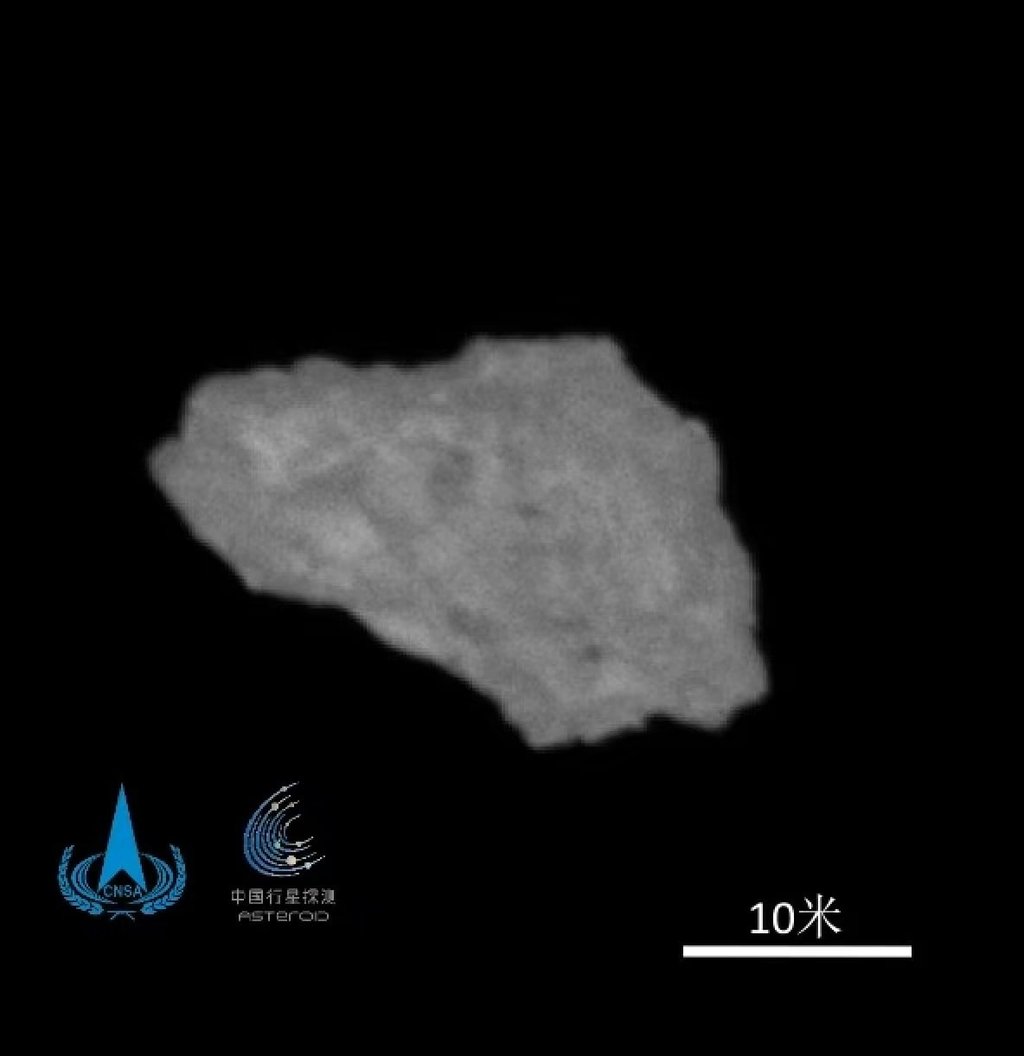
China’s Tianwen-2 spacecraft has captured its first close-up image of a near-Earth asteroid, revealing that the target is even smaller than anticipated – a factor scientists say will make the sample-return task “far more difficult” than previous Japanese and American missions.
The probe captured images about 20km (12.4 miles) from asteroid 2016 HO3 during its approach phase, the China National Space Administration (CNSA) announced on Monday.
The China National Space Administration released imagery of asteroid 2016 HO3 taken by Tianwen-2 probe from about 20km on July 2, 2026. Photo: CNSA/Xinhua

It was close enough for the spacecraft to begin scientific exploration of the asteroid, the agency said on its website.

Formally designated 2016 HO3, or asteroid 469219 Kamo‘oalewa, the target is a very small Apollo-type near-Earth asteroid previously estimated to measure about 40 to 100 metres (130 to 330 feet) in diameter. However, the image captured by Tianwen-2 and its accompanying scale bar suggests that the asteroid is likely to be less than 40 metres in diameter.

This makes it far smaller than Ryugu and Bennu – the targets previously explored by Japan and the United States – which are about 900 metres and 500 metres across, respectively.

“Based on the image released so far, this asteroid appears to be somewhat smaller than previously predicted – it seems to be only about 20 to 30 metres across, whereas the earlier estimate from our paper was around 57 metres,” said Zhang Pengfei, a researcher from the Institute of Geochemistry at the Chinese Academy of Sciences.

Advertisement
Select Voice
Select Speed
1.00x