China’s monster fish fossil reignites tetrapod evolution debate
A fossil discovered in Ningxia, China rekindles a debate over whether humans are descended from a predatory fish that lurked in prehistoric rivers and lakes

A fossil discovered at a quarry in Ningxia, China has rekindled a century-old evolutionary debate: could the common ancestor of humans and other four-limbed animals be a monster fish that once lurked in prehistoric rivers and lakes?
All members of the tetrapod family, including mammals, reptiles and amphibians, can trace their origins to a group of lobe-finned fish that made the leap from water to land about 360 million years ago. But just which fish deserves our thanks for this evolutionary step remains unclear.
Rhizodonts were the largest freshwater fish known to have ever swum on the planet. Some species have been estimated at as much as seven metres long. Their powerful jaws and crocodile-like fangs were designed to “grip and drag” full-sized sharks.
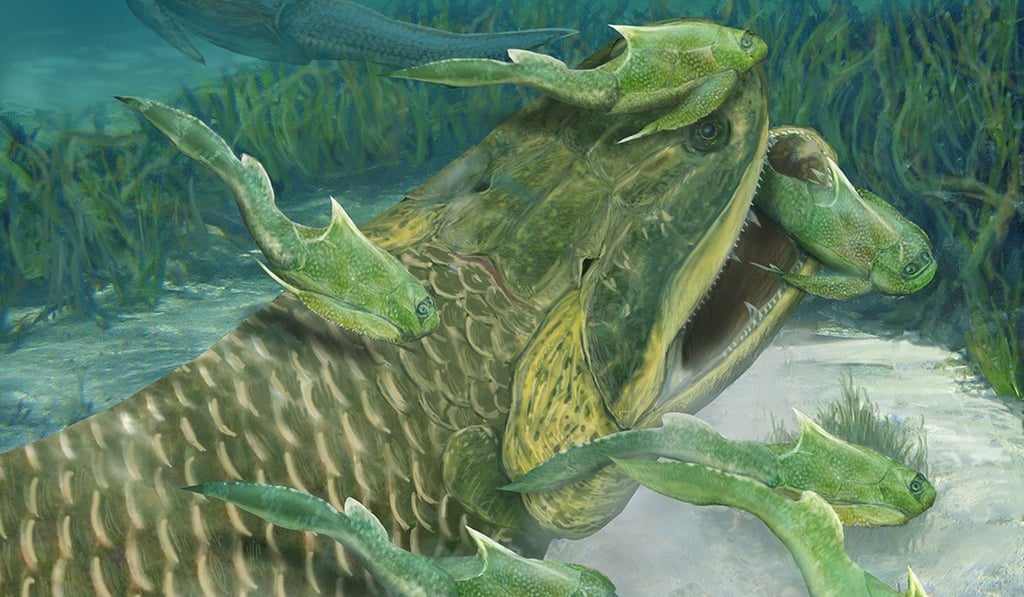
These extinct predators were once considered a possible ancestor of human beings.
In the 19th century, famous paleontologists such as Richard Owen, Thomas Huxley and Louis Agassiz had heated arguments over whether the rhizodonts had climbed ashore and ventured inland. The way in which the bones of the creatures’ paired fins were arranged was similar to that of four-limbed, land-living vertebrates, or tetrapods.