‘I just want someone who understands grandma’s needs’: how can Hong Kong get better carers for its ageing population?
With growing numbers of elderly – and a trend of more people living past the age of 100 – the city urgently needs younger people as geriatric care workers

On a warm spring afternoon in March and strapped to a wheelchair, 107-year-old Lee Tsz-yau showed barely any reaction as her daughter Tse Pui-king tried to tempt her with a plate of dim sum.
“Is being picky with food one of the reasons for her longevity?” Tse mused, as she put down the plate and fed her mother, who can hardly speak, hear or see, water from a plastic cup.
“She’s always refused to eat leftover food or anything tangy,” the 65-year-old said, adding that her mother used to reminisce about growing up in a wealthy landowning family on the mainland, with maids to prepare her lunch and feed her fruits picked from the family’s garden.
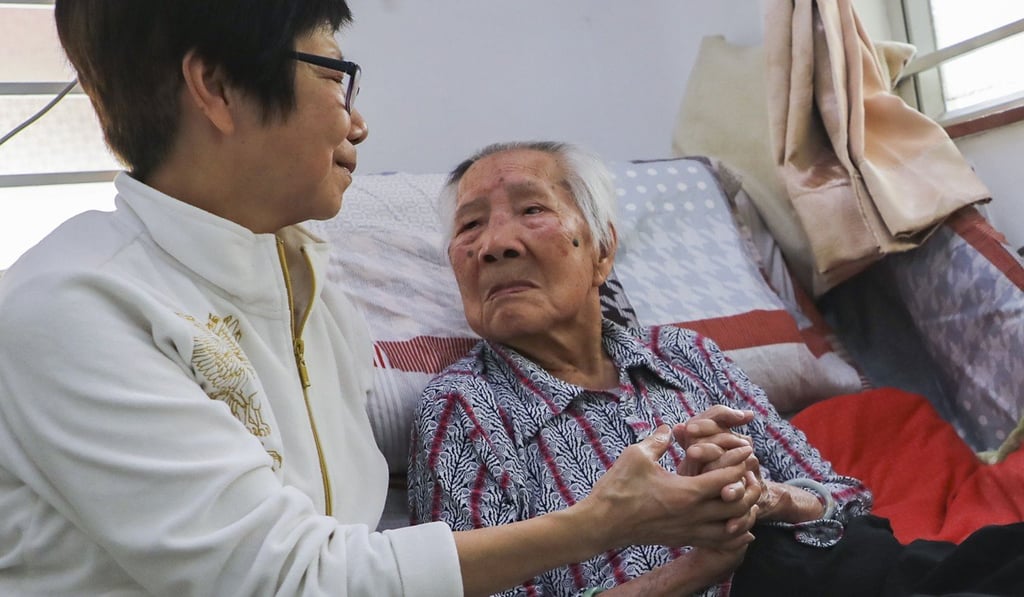
All that changed when Lee fled to Hong Kong in the 1950s to escape the political situation that destroyed her home and killed her father. She got married and had three children, including Tse. Her oldest has died, and her youngest lives on the mainland.
Today, Lee is among the city’s few thousand centenarians. There were 3,645 of them according to the 2016 by-census, almost 1.5 times more than 2006, with 85 per cent – or 3,111 – female. Like Lee, one-third do not live with their families but in “non-domestic households” such as care facilities.