Nobel Prize-winning discovery of gravitational waves sparks thirst for physics at Chinese University, scientist on project says
Historic detection of ripples sent through space-time provides boost for research efforts, professor says

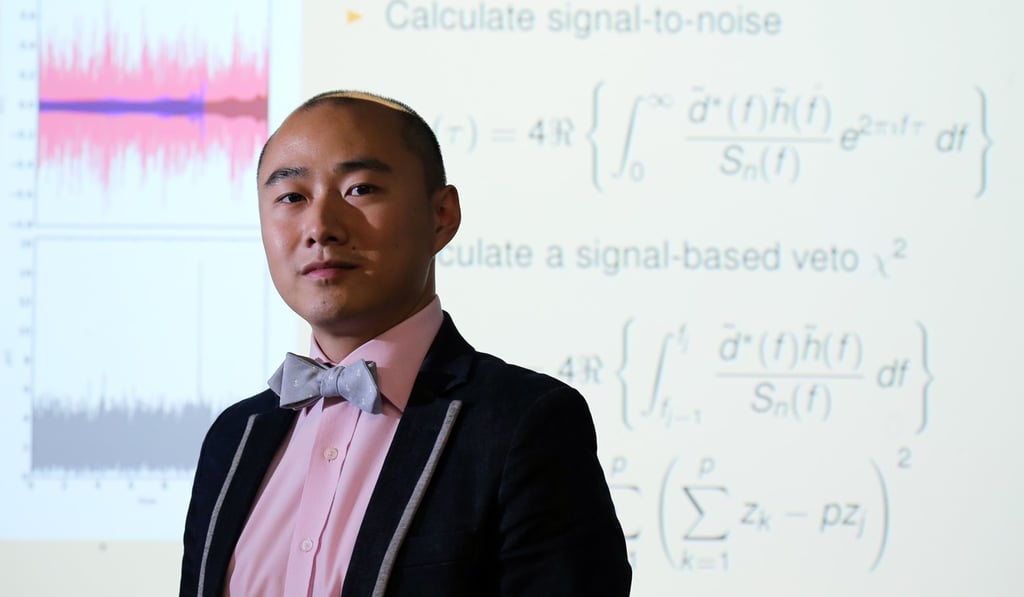
The Nobel Prize-winning discovery of gravitational waves – ripples in space-time caused by powerful energetic processes in the universe – has reinvigorated interest in physics at the Chinese University of Hong Kong, says a scientist based at the institution who was involved in the historic project.
“Ever since the detection of the waves, and even a little before that, we’ve been seeing a huge increase in student interest and students applying not just to this research group but other astronomy research groups,” said Professor Tjonnie Li, a theoretical physicist at the university’s physics department.
Detectors of gravitational waves win physics Nobel Prize
In September 2015, after decades of work, the Laser Interferometer Gravitational Wave Observatory (LIGO) in the United States made a groundbreaking discovery when it detected the ripples in the fabric of space-time – just as Albert Einstein predicted in his general theory of relativity a century ago.
The waves detected were caused by two colliding black holes a billion light years away.
On Tuesday, Rainer Weiss of the Massachusetts Institute of Technology, and Kip Thorne and Barry Barish of the California Institute of Technology, won the Nobel Prize in Physics for their work on the LIGO.