Chemicals in your sunscreen that cause birth defects and infertility found in Hong Kong fish by scientists from Baptist University
Five-year study shows toxins found in popular brands of sun lotion are already in sea around city, and raises concerns that they could enter the food chain

Chemicals that could leave people infertile, and are found in popular brands of sunscreen, have been discovered in fish in the sea off Hong Kong by scientists from Baptist University.
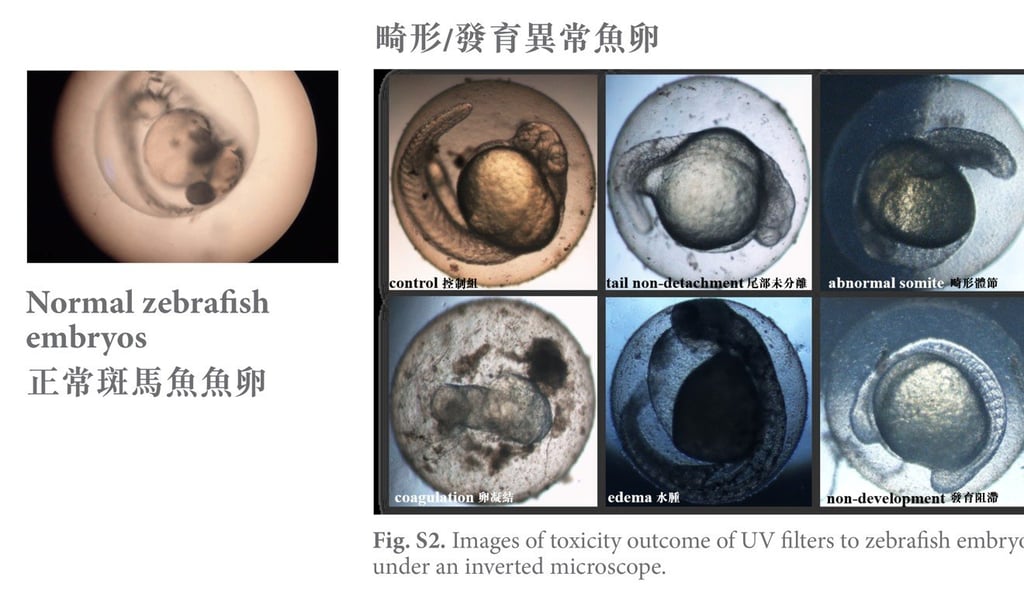
The findings, published in renowned scientific journal Environmental Science & Technology in August, were the result of a five-year study, and show a link between the chemicals and abnormalities or death in the offspring of zebrafish.
“Since more than 70 per cent of the genetic structure of zebrafish resembles that of humans, the effect of these contaminants passing along the food chain to humans and the long-term impact on human fertility cannot be neglected, ” said Kelvin Leung Sze-yin, the associate professor from the Chemical Department of the university.
The study, which was a world first, collected seawater samples from 30 locations off the Hong Kong coast, including at beach areas in Sai Kung, Southern Hong Kong Island, Tuen Mun, and at sewage treatment outfalls in Victoria Harbour, Tolo Harbour and West Tuen Mun.
Researchers found that Benzophenone-3 (BP-3), Ethylhexyl methoxycinnamate acid (EHMC) and Octocrylene (OC) were the three most abundant ultra violet (UV) filters in the samples.
In further experiments, the team fed zebrafish with polluted shrimp. After 47 days, the death rate of zebrafish embryos in 24 hours increased six times to nearly 60 per cent. While the 72-hour hatching rate decreased significantly from 80 per cent, to less than 30 per cent.