Hong Kong’s ozone pollution levels nearly doubled over two decades, report from local air-quality watchdog shows
- While Guangdong province industry widely seen as key factor in rise, city leadership encouraged to set internal goals to improve air quality
- Other pollutants decreased over same period, though remain far higher than air-quality goals set by World Health Organisation

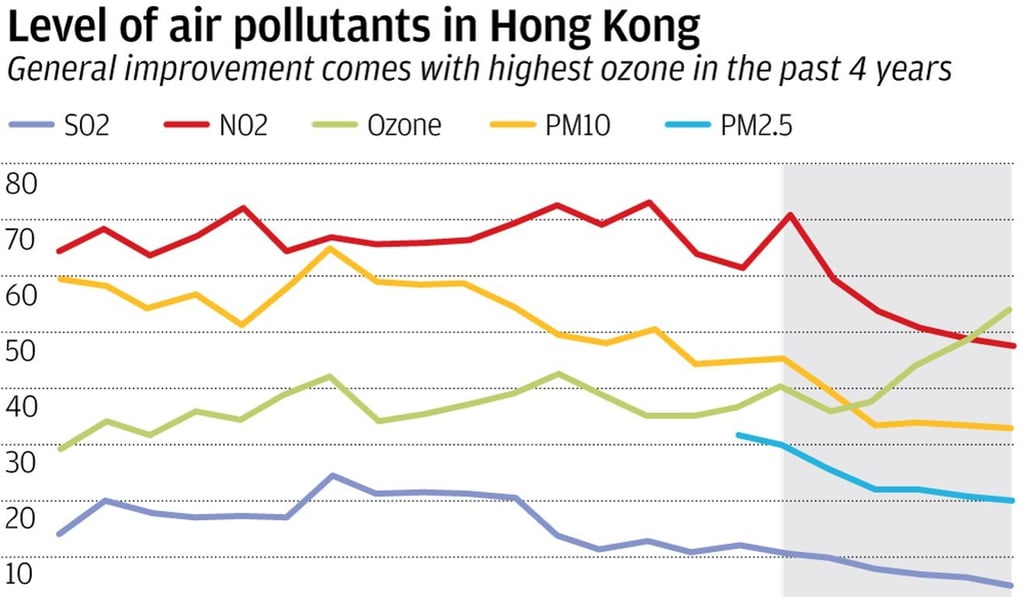
Levels of ozone, a major air pollutant and greenhouse gas, have nearly doubled in the past 21 years in Hong Kong, though certain other pollutants dipped in the same period, a study by a local air-quality watchdog revealed on Monday.
The Clean Air Network review, based on data from the Environmental Protection Department, found the yearly average concentration of ozone reached 54.29 micrograms per cubic metre in 2019, up from 29.56 in 1998.
Ozone pollution was particularly bad on the western side of Hong Kong, which included Tuen Mun, Yuen Long and Tai Po, although the highest level of ozone pollution was in Tseung Kwan O.
“The districts to the west of Hong Kong are particularly susceptible to regional air pollution and it is likely this is the reason for the high levels of ozone pollution there,” said Loong Tsz-wai, Clean Air Network’s senior community relations manager.
Ozone is formed when nitrogen oxides, emitted by vehicles, and volatile organic compounds (VOCs), emitted from such sources as paints, solvents and cosmetics, react with sunlight and oxygen, causing harmful smog that can lead to high levels of respiratory disease.