Hong Kong’s air quality on the mend, but most pollutant concentration levels ‘still fall short of WHO goals’
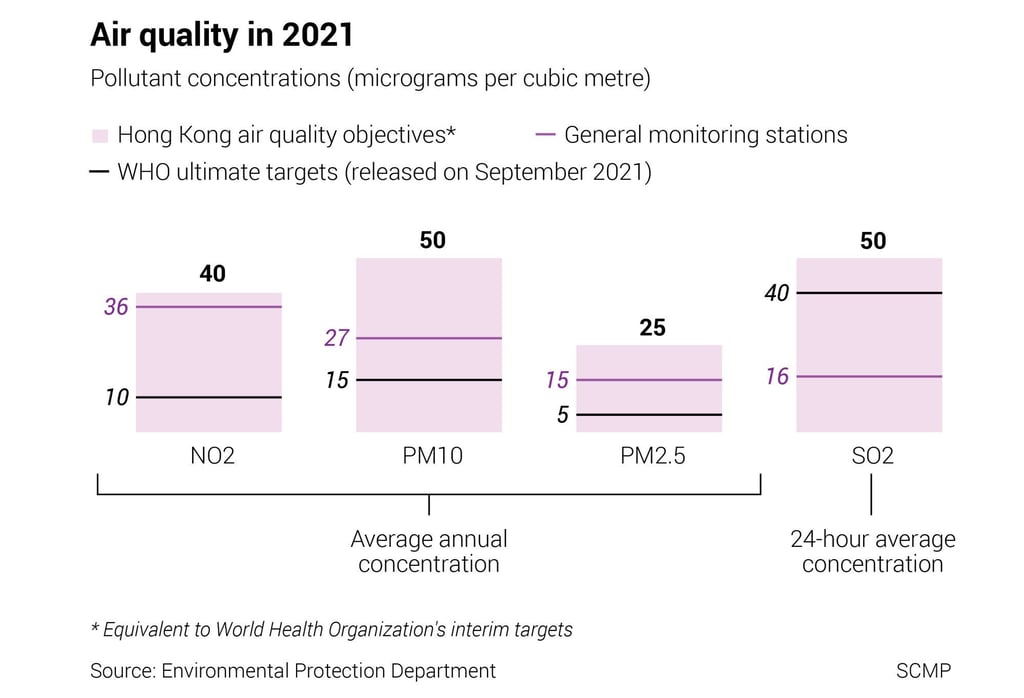
- Most major pollutant concentration levels in the city fell short of WHO standards, with only sulphur dioxide meeting the global body’s targets last year
- Environmental Protection Department says city’s air quality has been improving over the last 10 years, with the past two showing the best results

Only one pollutant, sulphur dioxide, had a concentration low enough to meet the WHO standard for the maximum allowable level last year, according to the Environmental Protection Department.
“Hong Kong’s air quality has been improving over the last 10 years, with the past two years having the best air quality,” Dr Kenneth Leung Kai-ming, assistant director of the department, said during a press conference on Friday.
While the pandemic had contributed to reduced transport and in turn better air quality over the past two years, especially during the first half of 2020, Leung said improvement had started before the outbreak.
“The Covid impact during the first half of 2020 was bigger than its impact for the entire 2021, but the air quality of 2021 was still better than that of 2019,” he said. “From the long-term perspective, the improvement trend has sustained.”
The air quality data recorded by the department’s monitoring stations showed that the annual average concentrations of respirable suspended particulates (PM10), fine suspended particulates (PM2.5), nitrogen dioxide (NO2) and sulphur dioxide (SO2) in the ambient air fell by 32 per cent to 62 per cent between 2011 and 2021.
The annual average concentrations of the pollutants at the roadside were reduced by 43 per cent to 58 per cent during the period.