Hong Kong government pilots fly into eye of typhoons to better understand their secrets
- Elaine Chan is among Government Flying Service pilots who fly weather data collection devices called dropsondes into heart of region’s worst storms
- Data allows Observatory to better predict typhoon paths and intensity, information it hopes to share more with national counterpart

When Super Typhoon Saola hit Hong Kong on September 1, government pilot Elaine Chan Yee-ling was flying into the eye of the storm, trying to steer her aircraft as turbulence made it violently shake.
Her mission was to deliver dropsondes, a cylindrical weather device packed with sensors, into the heart of Saola so key data about the storm could be collected for the Hong Kong Observatory.
“It was my first time in the eye of a typhoon,” the pilot recalled. “It was mesmerising, as I wasn’t able to see anything during my flight, but then the next second, it was all sunny and calm with a circular cloud surrounding me.”
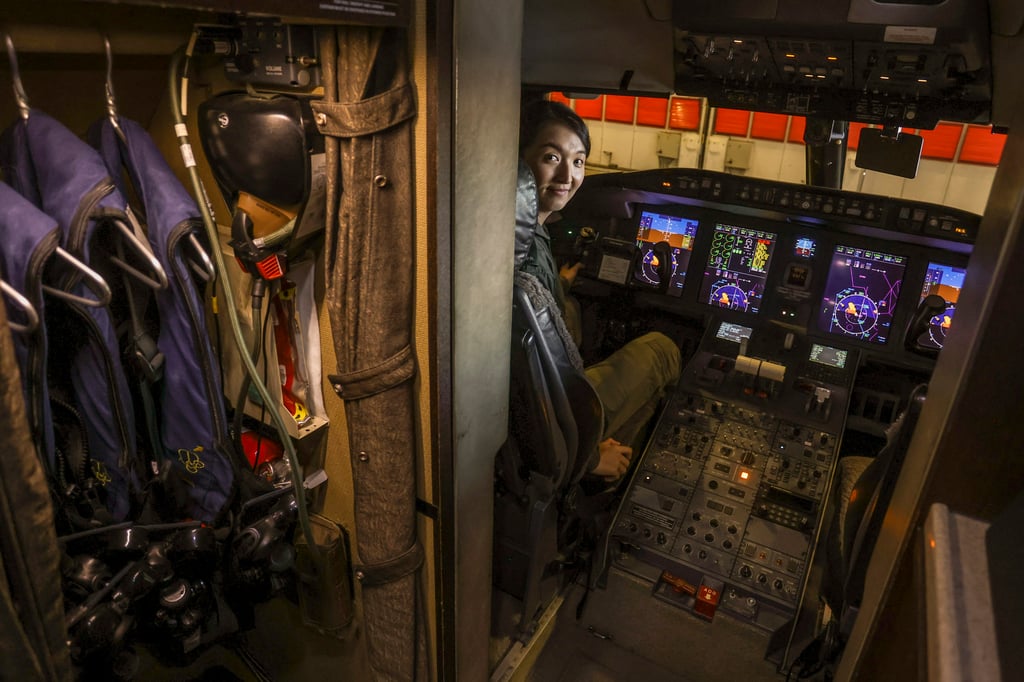
Pilots with the Government Flying Service have been braving the city’s roughest storms to collect meteorological data for the forecaster since 2011, racking up 81 trips as of last month.
According to Chan, pilots were often forced to make detours before reaching drop points inside the typhoon, flying to avoid the worst pockets of turbulence and hail while flying at 31,000 to 35,000 feet.
The dropsonde, which is attached to a parachute, records data on temperature, humidity, air pressure and wind speed, along with other storm conditions, at various altitudes as it drifts down towards the sea. The information allows the Observatory to improve its computer predictions on typhoon paths and intensity, according to Cheung Ping, senior scientific officer in aviation meteorological data analytics.
“A sensor on the wing of the plane can provide good data, but when used for tropical storm detection missions, it is limited to the same height as the plane is flying,” Cheung said.