Advertisement
ExclusiveCoronavirus: Hong Kong residents unhappy with Covid-19 response – and surgical masks one big reason why, Post survey shows
- Overwhelming majority of respondents say they, not the city government, will deserve credit if epidemic is beaten
- Survey shows level of dissatisfaction with government response climbs along with income, education levels
5-MIN READ5-MIN

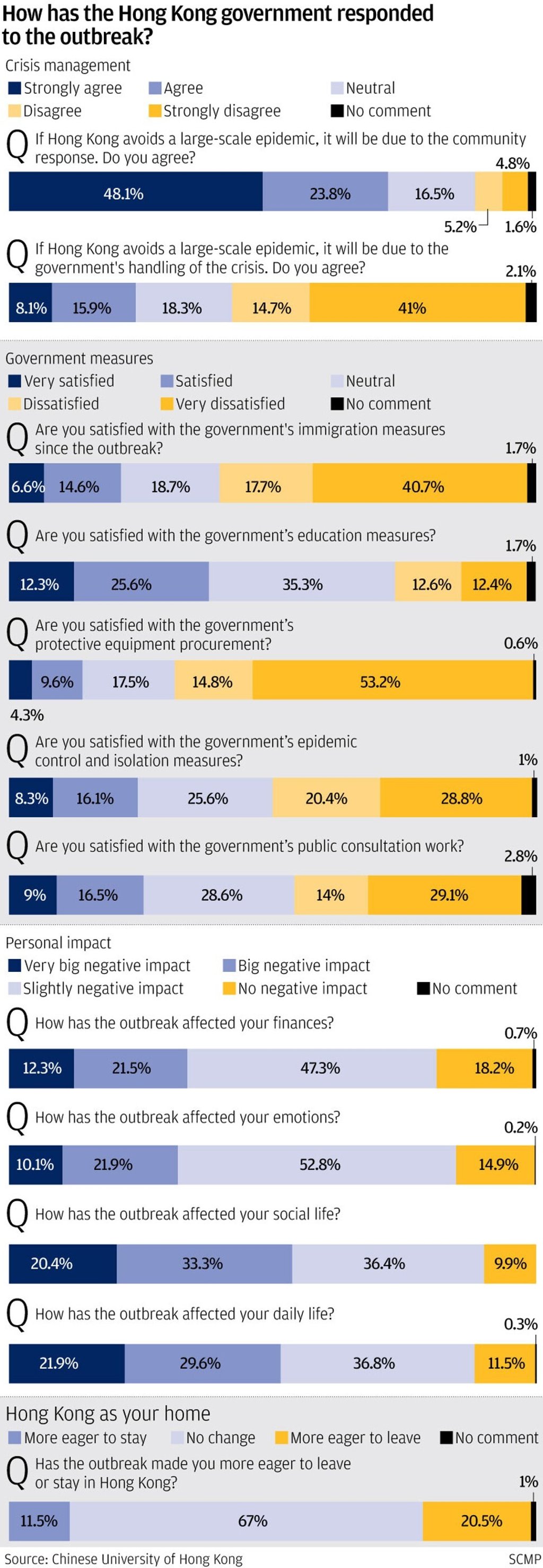
An overwhelming majority of Hong Kong residents are convinced they will have only themselves to thank rather than their embattled government if the city wins its battle against the Covid-19 pandemic, a survey commissioned by the Post has found.
Out of nearly 850 people polled, seven in 10 said they would credit the community response for beating the coronavirus, while more than half objected to the idea of Chief Executive Carrie Lam Cheng Yuet-ngor’s administration being commended for it.
And while the survey, conducted by the Chinese University of Hong Kong, reflected broad displeasure with the government’s performance to date, the scarcity of surgical masks and personal protective equipment for ordinary residents as well as medical professionals was the biggest bone of contention.
Advertisement
Most respondents rated the issue more distressing than immigration control, disruption to school life or the designation of quarantine centres and clinics in their neighbourhoods.
Advertisement
The survey also showed a marked contrast in residents’ opinions on the handling of the crisis based on income and education levels, with wealthier and more educated respondents displaying less faith in the government’s efforts.
Analysts and medical experts said the study indicated most Hongkongers, many of whom lived through the severe acute respiratory syndrome (Sars) crisis of 2003, were deeply upset by the government’s epidemic response, and that the onus was now on officials to better address their concerns.
Advertisement
Select Voice
Select Speed
1.00x