Hong Kong officials admit for first time failure to boost public housing supply in short term, but vow enough homes in coming decade
- Deputy Financial Secretary Michael Wong says this was why ‘light public housing’ scheme was raised in city leader’s policy address a day earlier
- Finance chief Paul Chan however reassures public that land identified will yield 493,000 public and private homes by 2033, at least 60,000 more than original target

Top Hong Kong officials have conceded for the first time that they failed to boost public housing supply in the short term, while assuring residents that in the coming decade there will be more than enough homes for people.
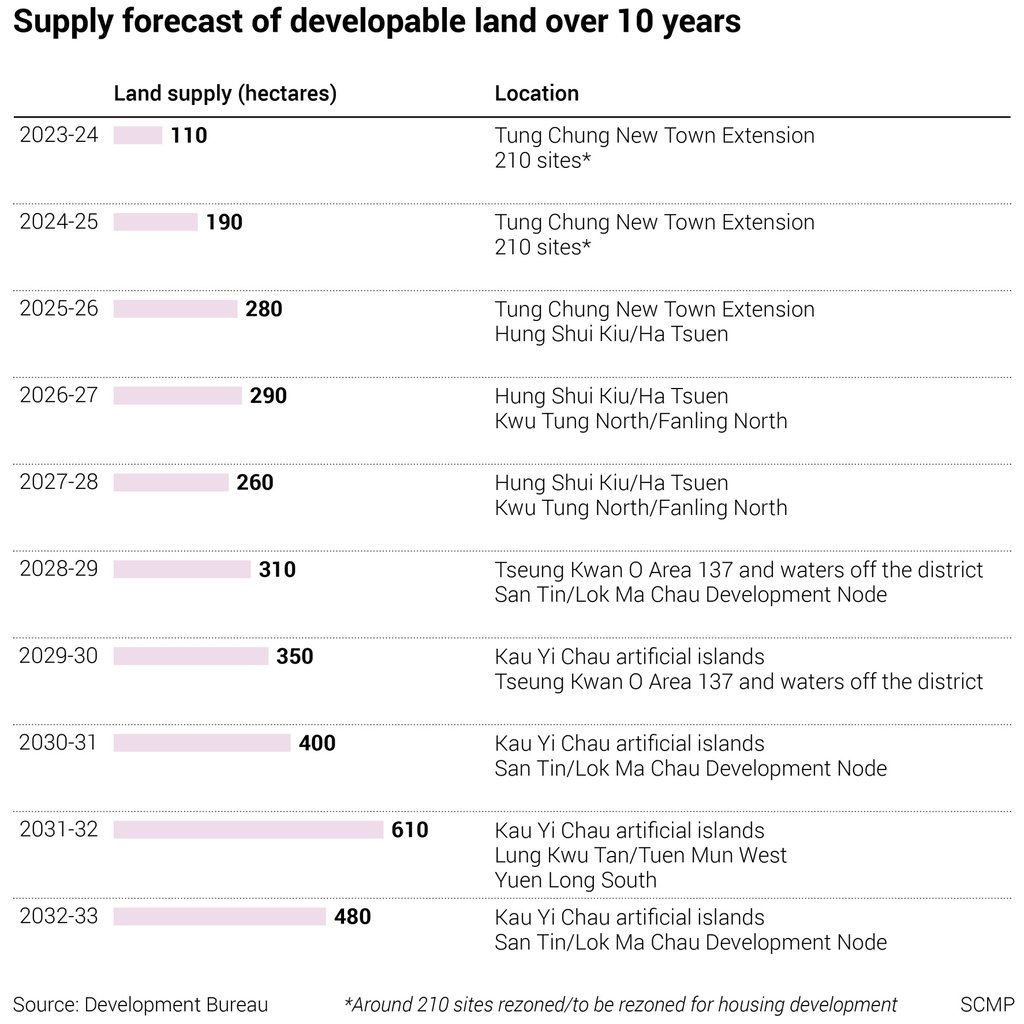
Financial Secretary Paul Chan Mo-po on Thursday said “at least 3,280 hectares” of land had been identified to be developed by 2023, equivalent to the size of Sha Tin and Ma On Shan districts in the New Territories. The land will yield 493,000 public and private homes by 2033, at least 60,000 more than the original target.
“With substantial and sustained efforts in land production, the situation of stringent supply in the past is now greatly reversed, which will allow us to cope with extreme demand if it happens,” Chan told a press conference on housing and land initiatives that were rolled out a day earlier in the city leader’s policy address.
But Deputy Financial Secretary Michael Wong Wai-lun conceded that the government had failed to put in place steps to further boost public housing supply over the next five years, which led to the creation of the Light Public Housing scheme mentioned in the latest policy blueprint, an improved version of existing transitional homes.
“It is objective reality,” he said. “Currently for us to construct conventional public housing, it [takes] up to 60 months. In other words, if we continue to make use of conventional public housing as the only solution, then actually we would not be able to increase the supply for the coming five years.”
The new project – seen as a highlight of Chief Executive John Lee Ka-chiu’s maiden report – is designed to yield 30,000 better transitional homes built on temporary sites. The flats, which will have cheaper rent, will come with basic facilities such as air conditioners and water heaters, and are aimed at reducing the waiting time for public housing from six years to 4½ by 2026-27.