Advertisement
Archaeology and palaeontology
People & CultureEnvironment

Body armour, permanent teeth and a cousin in Vietnam: discovery in China sheds light on fish from hundreds of millions of years ago

  • A fossil found in Chongqing is believed to belong to a new species of fish from the Silurian Period
  • The discovery provides information about a major evolutionary split among fish

3-MIN READ3-MIN
A 423-million-year-old jawed fish fossil has been found in southwest China's Chongqing Municipality and was introduced to the public on June 21, 2021. Photo: Handout
Kevin McSpadden

Imagine sitting down to a meal of steamed fish at one of Hong Kong’s iconic street food restaurants – pulling out the plastic chair and settling down with a cold bottle of Tsingtao for conversation with friends – but, when the fish arrives, it becomes clear the process would require battling through a suit of armour.
If humans lived in China 423 million years ago, this may very well have been the situation for such hypothetical gatherings because a class of fish called placoderms, famous for being covered in armour, roamed the ancient oceans.
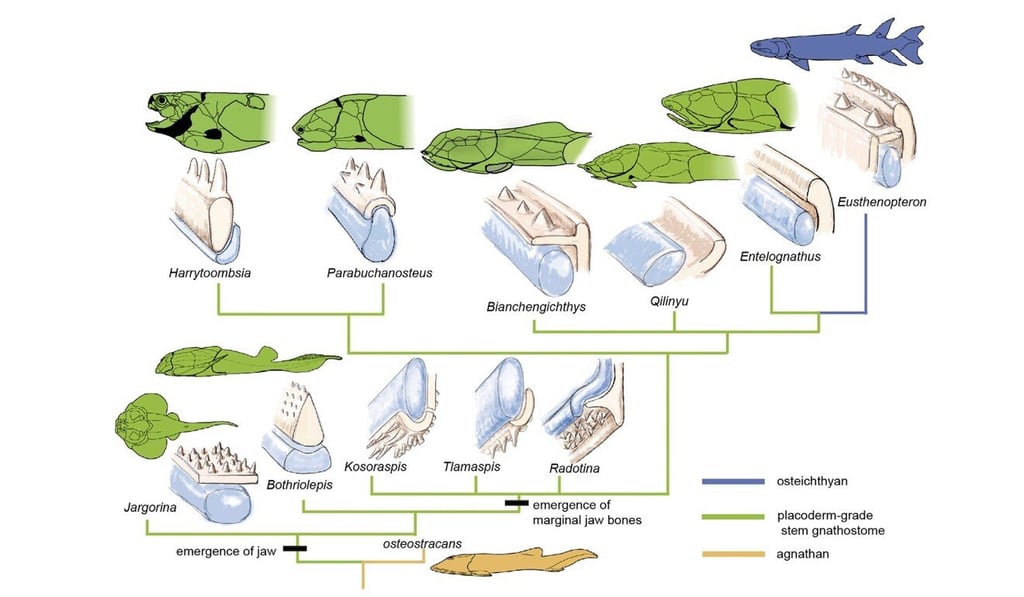
Earlier in June, paleontologists in China announced the discovery of a new species of placoderm, called Bianchengichthys micros, which was found in Chongqing, a municipality in southwest China. The discovery was revealed in a paper in Current Biology in mid-June.
Advertisement
A chart from the paper announcing the discovery shows the transition between placoderms (the green line) and bony fish (the blue line). ‘Bianchengichthys’ is the new discovery. Photo: Institute of Vertebrate palaeontology and Paleoanthropology

The discovery provided an important data point in understanding an important evolutionary split that happened hundreds of millions of years ago during the Silurian Period, which was part of the Paleozoic Era predating the dinosaurs.

Advertisement

About 420 million years ago, fish split along two distinct evolutionary roads — bony fish, which make up most modern fish, and cartilaginous fish, which include sharks and rays. The new fossil is believed to belong to a species of fish that is close to the last common ancestor of both types of fish.

Advertisement
Select Voice
Select Speed
1.00x