-
Advertisement
Archaeology and palaeontology
People & CultureEnvironment

Prehistoric owls: New study theorises that a pterosaur species vomited undigested food as a pellet

  • The pterosaur lived during the Jurassic period in what is now northern China
  • The scientists found two examples of pterosaurs fossilised next to what they believe are regurgitated food pellets

Reading Time:2 minutes
Why you can trust SCMP
A new study found that pterosaurs (left), a prehistoric flying reptile, probably vomited food pellets much in the same way as owls. Photo: Handout
Kevin McSpadden

For many young schoolchildren, a highlight of their education is dissecting owl pellets to unearth the undigested remains of their preys.

Now, evidence suggests that, much like owls, certain pterosaur species vomited food that they could not digest as pellets.
A recent study published in the Royal Society, a peer-reviewed journal, found direct evidence that a species of pterosaurs probably regurgitated its food. The scientists found pellets containing fish scales near two specimens of Kunpengopterus sinensis found in China, one adult and one juvenile.
Advertisement

“It probably vomited the pellets, indicating the presence of two-part stomachs and efficient antiperistalsis in both juveniles and adults,” the team wrote in the report. Antiperistalsis are stomach contractions that force digested food out of the mouth rather than the normal direction for digestion.
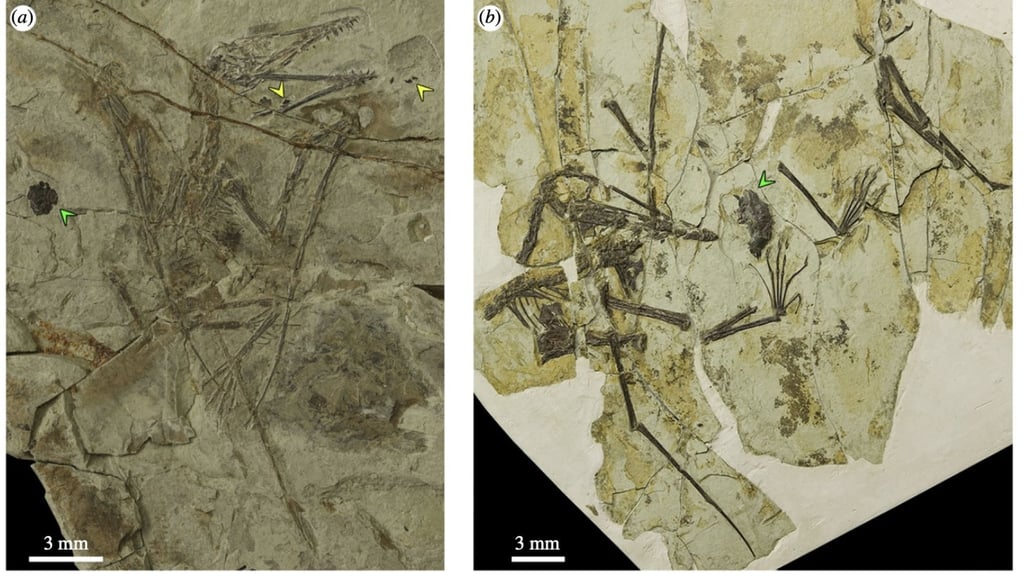
Green arrows point to fossils that scientists say are regurgitated pellets. The yellow arrows point to fossilised fish scales. Photo: Royal Society

One pterosaur was found near smaller pellets, ranging between 10-12mm in diameter, while another specimen featured a longer pellet, about 42mm in length and 16mm across. The presence of fish scales led the scientists to theorise that they are fossilised pellets, called emetolites, and not faeces, known as coprolites.

Advertisement
Advertisement
Select Voice
Choose your listening speed
Get through articles 2x faster
1.25x
250 WPM
Slow
Average
Fast
1.25x