Is the acai berry craze boon or threat for the Amazon?
- The acai craze has unleashed an economic boom for farmers and been lauded as a way to bring ‘green development’ to the rainforest without destroying it
- Experts say, however, that it is also threatening the Amazon’s biodiversity, as single-crop fields of acai palms become increasingly common

Working in the sweltering heat of the Brazilian Amazon, Jose Diogo scales a tree and harvests a cluster of black berries: acai, the trendy “superfood” reshaping the world’s biggest rainforest – for better and worse.
Diogo, 41, who lives in a poor, remote community founded by escaped slaves, is a world away from the upscale supermarket aisles of New York or Tokyo, where berries like these are sold in sorbets, smoothies, juices, powders and pills, popularised by the likes of Gwyneth Paltrow and Meghan Markle.
But he has a front-row view of the changes the acai craze is bringing to the Brazilian Amazon.
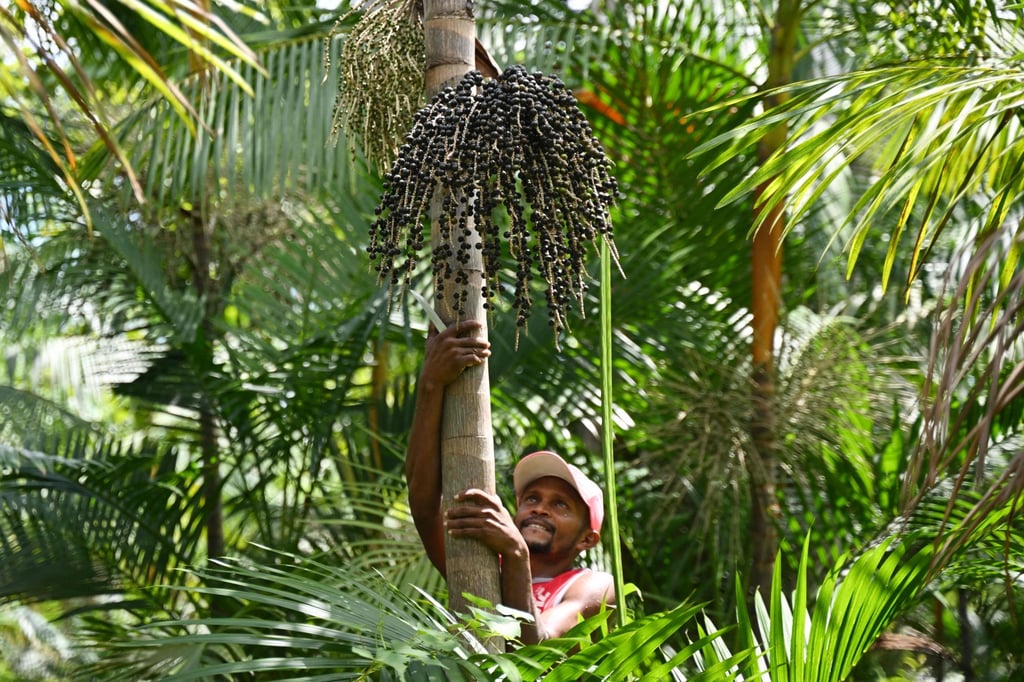
Since acai rose to international fame in the 2000s, touted for its rich nutritional and antioxidant properties, it has unleashed an economic boom for traditional farmers in the Amazon region, and been lauded as a way to bring “green development” to the rainforest without destroying it.
But experts say it is also threatening the Amazon’s biodiversity, as single-crop fields of acai palms become increasingly common.
Diogo, who lives in the village of Igarape Sao Joao, in the northern state of Para, is building himself a brick house thanks to the money he has made from acai.
“Things get a lot better for us every harvest season,” he says, scraping the small berries into a large basket.