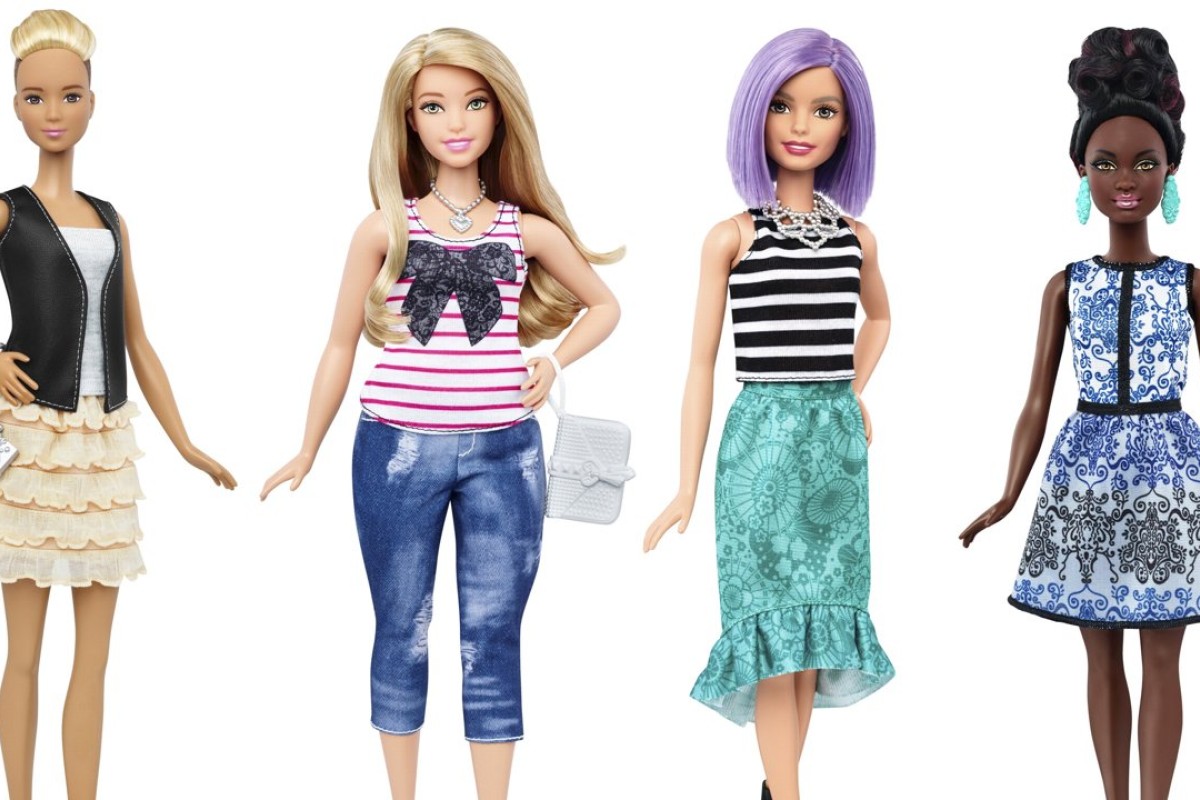
Poor Barbie. She’s just undergone extensive plastic surgery to become more socially acceptable. But a lot of her critics still don’t like her.

But Kris Macomber, who teaches sociology at Meredith College in Raleigh, North Carolina, says she’s “reluctant to celebrate Barbie’s new strategy because it doesn’t change the fact that Barbie dolls and other kinds of fashion dolls still over-emphasise female beauty. Sure, all body types should be valued. And, sure, all skin colours should be valued equally. But why must we keep sending girls the message that being beautiful is so important?”
Josh Golin, executive director of the Campaign for a Commercial-Free Childhood, said Barbie’s changes are a testament to activists who for years have challenged her “unrealistic and harmful body type.” But body type “was only one of the criticisms,” he said. “The other was the brand’s relentless focus on appearance and fashion.”
Kumea Shorter-Gooden, co-author of Shifting: The Double Lives of Black Women in America, has said in the past that Barbie has a bigger impact on black girls struggling with messages about skin colour and hair. Shorter-Gooden applauded Mattel “for diversifying the size and look of Barbie,” but noted that “European-American hair still prevails,” and that the dolls’ outfits still “convey a traditional and constraining gender norm about how girls and women should look.”
Aside from whether Barbie’s looks will ever measure up to society’s changing expectations, another question worth asking is whether kids still want to play with Barbies. Barbie sales fell 14 percent in the most recently reported quarter, with worldwide sales falling every year since 2012. A study by BAV Consulting found that consumers perceive the Barbie brand as being “less relevant” than 80 percent of 3,500 brands in 200 categories BAV studied. BAV’s data analysis also found that consumers perceive Barbie as being in the bottom third of all brands when it comes to social responsibility but in the top 2 percent when it comes to being traditional.