Scientists capture incredible photographic proof of a landslide on a comet, exposing icy subsurface

It was 3am, and astronomer Maurizio Pajola had been up for hours looking through images taken by the Rosetta spacecraft of its dumpy, duck-shaped comet. Pajola had just started a new job studying Mars’ moon Phobos at NASA’s Ames Research Centre. The only time he could continue this work on the Rosetta mission was the middle of the night.

The next image, taken by one of Rosetta’s less powerful cameras on July 10, showed a plume of gas and dust bursting from the comet. Five days later, OSIRIS got another good look at the site in question. The cliff face had collapsed, revealing the radiant material beneath.
In a paper published Tuesday in the journal Nature Astronomy, Pajola and his colleagues report that the event he spotted was a landslide - the first captured on a comet. The collapse of the dark organic material coating the cliff face revealed that pristine water ice lies beneath the comet’s surface, the scientists say.
The landslide was the most dramatic of several geologic phenomena that Rosetta scientists have witnessed on Comet 67P/Churyumov-Gerasimenko, a lump of ice and rock about the size of Mount Fuji. In a second paper published in the journal Science, the astronomers describe how the comets’ surface is constantly changing as a result of its rotation and the glare of the sun.
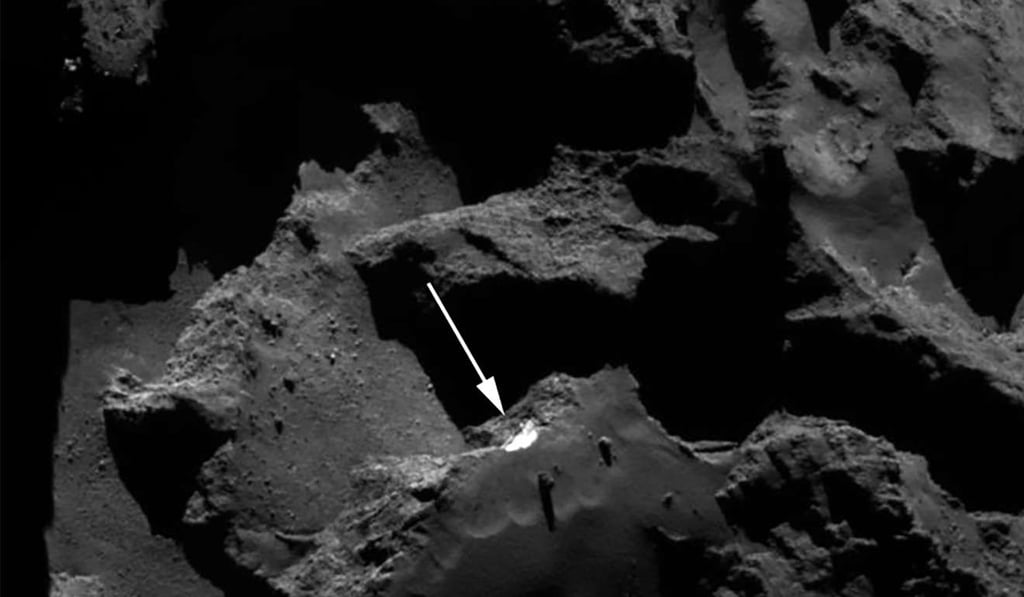
The landslide, which took place sometime around July 10, 2015, would not have looked like a landslide on Earth. Comet 67P is so small it hardly has any gravity, so instead of tumbling down like an avalanche, much of the material that broke off from the fractured cliff face produced an “outburst.” Some 22,000 cubic metres of material, enough to fill nine Olympic swimming pools, puffing up above the surface to form a cloud of dust and gas. This suggests an unambiguous link between outbursts (which give comets their characteristic comas) and destructive events like landslides, the scientists say.