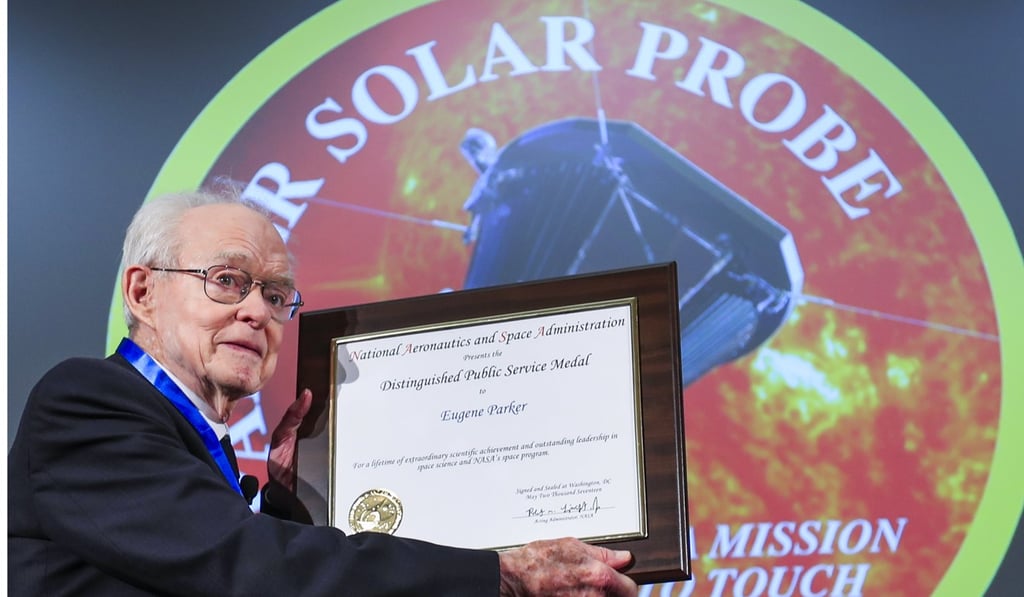
A new Nasa mission aims to brush by the sun, coming closer than any spacecraft in history to its scorching heat and radiation in order to reveal how stars are made, the US space agency said Wednesday.
After lift-off from Kennedy Space Centre in Florida in July 2018, the Parker Solar Probe will become the first to fly directly into the sun’s atmosphere, known as the corona.
The plan for the unmanned spacecraft is to orbit within 6.3 million km of the sun’s surface.
Advertisement
Temperatures in that region exceed 1,377 Celsius, for which the spacecraft is equipped with an 11.5cm-thick carbon-composite shield.
Dr Eugene Parker is presented the Nasa Distinguished Public Service Medial and Certificate at the introduction of the Parker Solar Probe, named in his honour, at the William Eckhardt Research Centre at the University of Chicago on Wednesday. Photo: EPA
Advertisement
Roughly the size of a small car, the probe will make seven fly-bys of the sun over a seven-year period, in what Nasa described as a “mission of extremes”.