Advertisement
Space
World

Astronomers discover 12 new moons orbiting Jupiter – one on collision course with the others

The fresh haul of natural satellites brings the total number of Jovian moons to 79

2-MIN READ2-MIN
Nasa's Juno spacecraft captures Jupiter's southern hemisphere, as the spacecraft performed its 13th close fly-by of Jupiter on May 23, 2018. Photo: Nasa via Reuters
The Guardian

One of a dozen new moons discovered around Jupiter is circling the planet on a suicide orbit that will inevitably lead to its violent destruction, astronomers say.

Researchers in the US stumbled upon the new moons while hunting for a mysterious ninth planet that is postulated to lurk far beyond the orbit of Neptune, the most distant planet in the solar system.
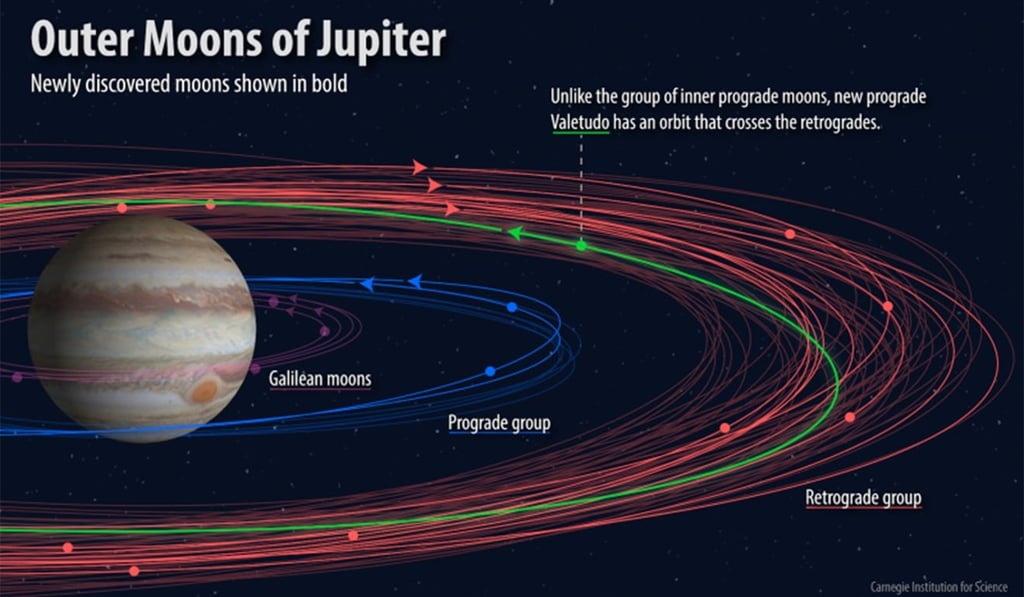
The team first glimpsed the moons in March last year from the Cerro Tololo Inter-American Observatory in Chile, but needed more than a year to confirm that the bodies were locked in orbit around the gas giant. “It was a long process,” said Scott Sheppard, who led the effort at the Carnegie Institution for Science in Washington DC.
Various groupings of Jovian moons with the newly discovered ones shown in bold. The “oddball” called Valetudo after the Roman god Jupiter's great-granddaughter, has a prograde orbit that crosses the retrograde orbits. Artwork: Roberto Molar-Candanosa/Carnegie Institution for Science
Advertisement

Jupiter, the largest planet in the solar system, was hardly short of moons before the latest findings. The fresh haul of natural satellites brings the total number of Jovian moons to 79, more than are known to circle any other planet in our cosmic neighbourhood.

Valetudo is like driving down the highway on the wrong side of the road … head-on collisions are likely
Scott Sheppard, Carnegie Institution for Science

Nine of the new moons belong to an outer group that orbit Jupiter in retrograde, meaning they travel in the opposite direction to the planet’s spin. They are thought to be the remnants of larger parent bodies that were broken apart in collisions with asteroids, comets and other moons. Each takes about two years to circle the planet.

Advertisement
Advertisement
Select Voice
Select Speed
1.00x