Nobel Prize in Physics divided between Roger Penrose, Reinhard Genzel and Andrea Ghez for black hole research
- The prize was awarded to the British, German and US scientists for their work on the formation of black holes
- The Nobel Prize for Medicine was awarded to Americans Harvey Alter, Charles Rice and Briton Michael Houghton for the hepatitis C virus discovery
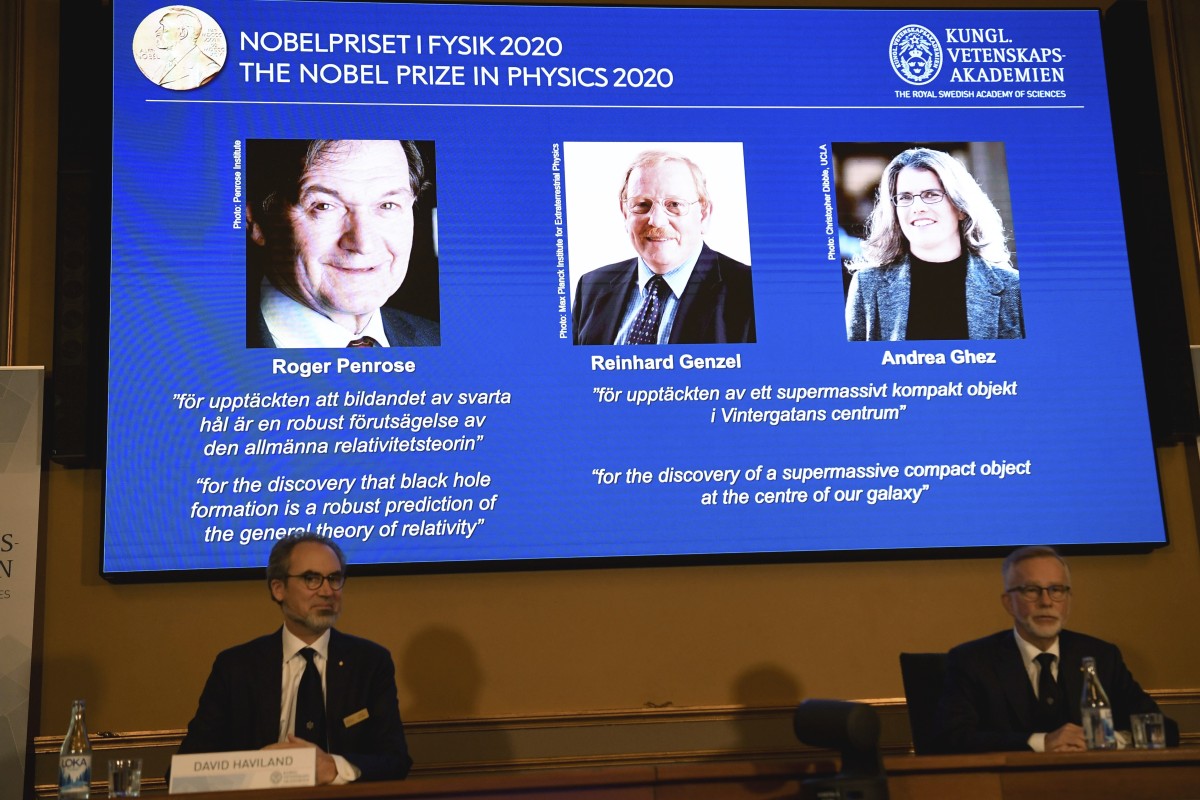
Penrose, 89, professor at the University of Oxford, won half the prize for his work using mathematics to prove that black holes are a direct consequence of the general theory of relativity.
Genzel, 68, of the Max Planck Institute and University of California, Berkeley, and Ghez, 55, at the University of California, Los Angeles, shared the other half for discovering that an invisible and extremely heavy object governs the orbits of stars at the centre of our galaxy.
Recipients of prizes in the fields of chemistry, literature and peace will be announced later this week. The economics award is due next week.
Among the Nobel Prizes, physics has often dominated the spotlight with past awards going to scientific superstars such as Albert Einstein for fundamental discoveries about the make-up of the universe, including the general theory of relativity.