Sarcastic applause and tepid approval for German Social Democrats’ coalition talks with conservative Merkel

Germany has inched one step further towards forming a new government after the centre-left Social Democratic Party (SPD) gave its lukewarm endorsement of a renewed Angela Merkel-led “grand coalition”.
At a special SPD congress in Bonn that welcomed a speech by the party’s leader, Martin Schulz, with sarcastic applause and saw standing ovations for his fiercest critics, 56 per cent of the party’s delegates voted in favour of moving on to the second and final stage of coalition talks with Merkel’s centre-right Christian Democratic Union (CDU).
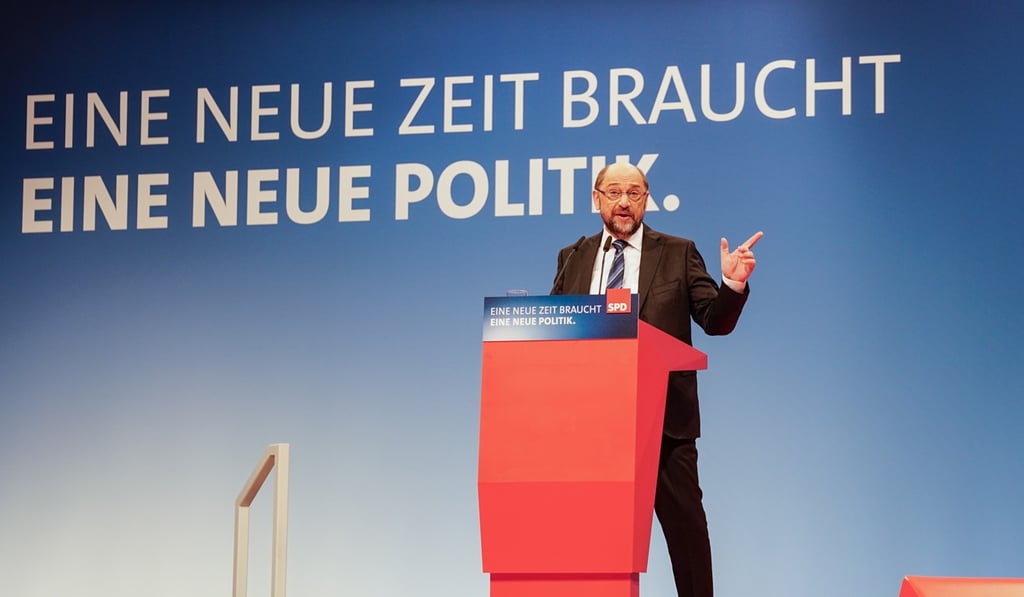
After attempts to form an unorthodox coalition between the CDU, the pro-business Free Democrats and the Green party collapsed in November, a no vote from SPD delegates would not only have put Schulz’s job on the line but raised new questions over Merkel’s future.
“The SPD must and will be visible, audible and recognisable,” Schulz had vowed at the end of a week spent rallying support at party offices across the country.
The former president of the European parliament defended the results of the initial phase of exploratory talks with Merkel’s centre-right party, insisting that the resulting coalition paper represented “a revolution” in German education policy as well as “a manifesto for a European Germany”.