Nearly 70-year-old maths problem partly solved by amateur
Well-known biologist spurs on search for solution to the Hadwiger-Nelson question after decades of stagnation

An amateur mathematician has made the first breakthrough in more than 60 years towards solving a well-known maths problem.
Aubrey de Grey, who is more widely known as a maverick biologist intent on extending the human lifespan, has taken the academic world by surprise after announcing a new solution to the so-called Hadwiger-Nelson problem.
The problem sounds deceptively simple, but despite professionals spending years trying to crack it, progress stalled soon after the puzzle was first posed in 1950.
“Literally, this is the first progress in more than 60 years,” said Gil Kalai, a mathematician at Hebrew University of Jerusalem.
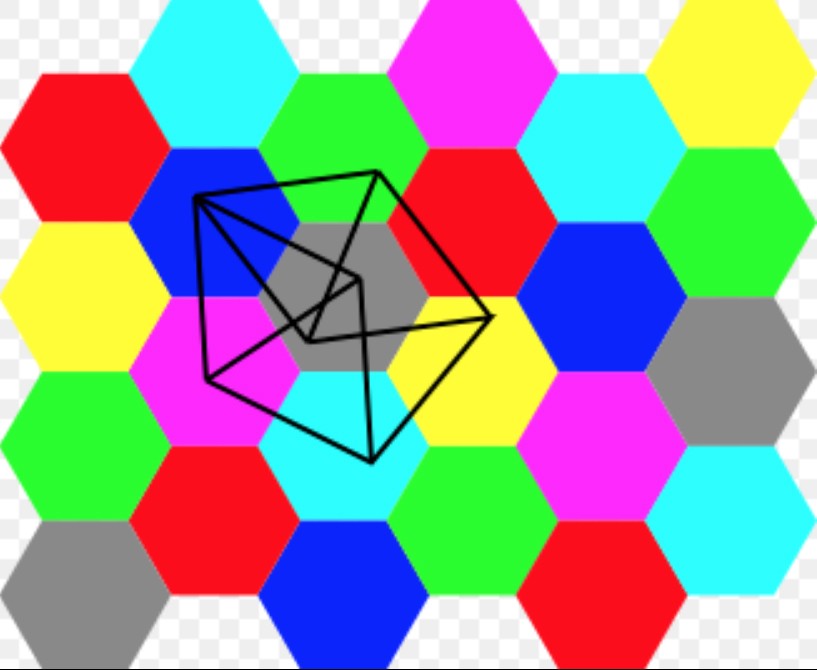
The problem is as follows. Imagine a collection of dots connected by lines. The dots can be arranged any way at all, the only rule is that all the connecting lines must be of equal length. For instance, in a square the diagonal would not be joined up, but the outer edges would be. Now, colour in all the dots so that no two connected points have the same colour. How many colours are required?