Cosmic collision course: nearby galaxy set to hit Milky Way, say scientists
- Event could eject ‘entire solar system into outer space’, but might also delay destruction of our galaxy by a couple of billion years

Astronomers have declared that a nearby galaxy will slam into the Milky Way and could knock our solar system far into the cosmic void.
The unfortunate discovery was made after scientists ran computer simulations on the movement of the Large Magellanic Cloud (LMC), one of the many satellite galaxies that orbits the Milky Way. Rather than circling at a safe distance, or breaking free from the Milky Way’s gravitational pull, the researchers found the LMC is destined to clatter into the galaxy we call home.
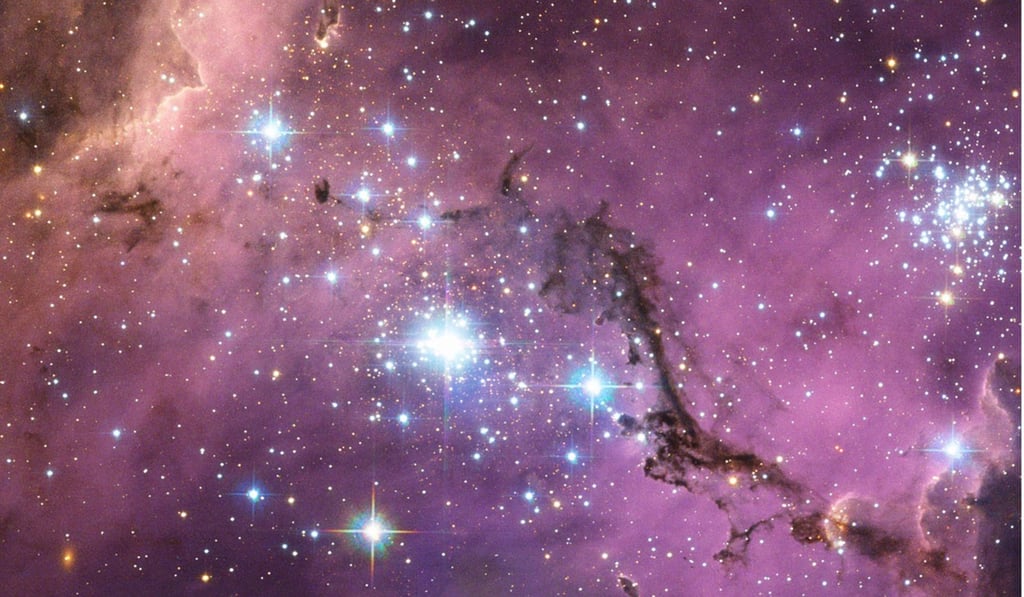
At the moment, the LMC is estimated to be about 163,000 light years from the Milky Way and speeding away at about 400km per second (250 miles per second). But simulations by astrophysicists at Durham University show that the LMC will eventually slow down and turn back towards us, ultimately smashing into the Milky Way in about 2.5 billion years’ time.
While individual stars and planets are unlikely to collide, the arrival of a galaxy weighing as much as 250 billion suns will still wreak havoc.
“The whole of the Milky Way will be shaken and the entire solar system could be ejected into outer space,” said Carlos Frenk, director of the Institute for Computational Cosmology at Durham. “If that happens, I don’t see how our descendants, if we have any, will be able to withstand it.”