Sotheby’s hopes for record US$30 million sale of ancient Hebrew Bible
- The 1,100-year-old leather-bound, handwritten parchment tome known as the Codex Sassoon contains almost the entirety of the Hebrew Bible
- On Wednesday Tel Aviv’s ANU Museum of the Jewish People opened a week-long exhibition of the manuscript, part of a tour of the artefact in the UK, Israel and US

One of the oldest surviving biblical manuscripts, a nearly complete 1,100-year-old Hebrew Bible, could soon be yours – for a cool US$30 million.
The Codex Sassoon, a leather-bound, handwritten parchment tome containing almost the entirety of the Hebrew Bible, is set to go on the block at Sotheby’s in New York in May. Its anticipated sale speaks to the still bullish market for art, antiquities and ancient manuscripts even in a worldwide bear economy.
Sotheby’s is drumming up interest in hopes of enticing institutions and collectors to bite. It has put the price tag at an eye-watering US$30 million to US$50 million.
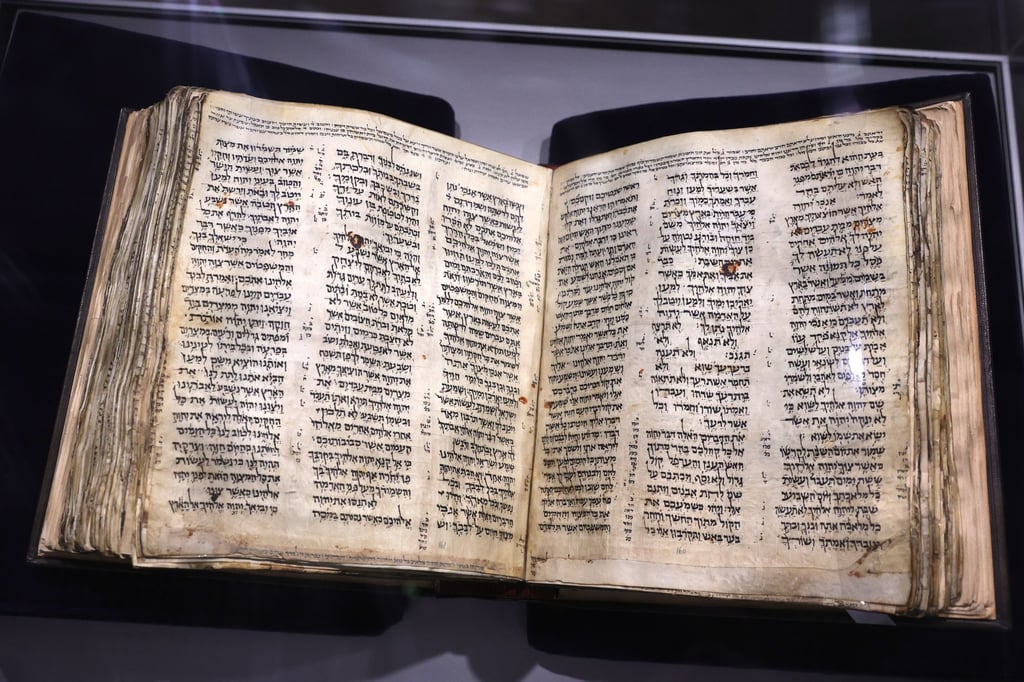
On Wednesday, Tel Aviv’s ANU Museum of the Jewish People opened a week-long exhibition of the manuscript, part of a whirlwind worldwide tour of the artefact in the United Kingdom, Israel and the US before its expected sale, on Wednesday.
“There are three ancient Hebrew Bibles from this period,” said Yosef Ofer, a professor of Bible studies at Israel’s Bar Ilan University: the Codex Sassoon and Aleppo Codex from the 10th century, and the Leningrad Codex, from the early 11th century.
Only the Dead Sea Scrolls and a handful of fragmentary early medieval texts are older, and “an entire Hebrew Bible is relatively rare”, he said.
Starting a few centuries before the Codex Sassoon’s creation, Jewish scholars known as Masoretes started codifying oral traditions of how to properly spell, pronounce, punctuate and chant the words of Judaism’s holiest book. Unlike Torah scrolls, where the Hebrew letters are devoid of vowels and punctuation, these manuscripts contained extensive annotation instructing readers how to recite the words correctly.