Astronomers find seven Earth-size planets orbiting ‘nearby’ star 40 light-years away
When astronomers eyeball little stars twinkling through their telescopes, they now know for certain that circling around some of them are worlds not unlike our own.
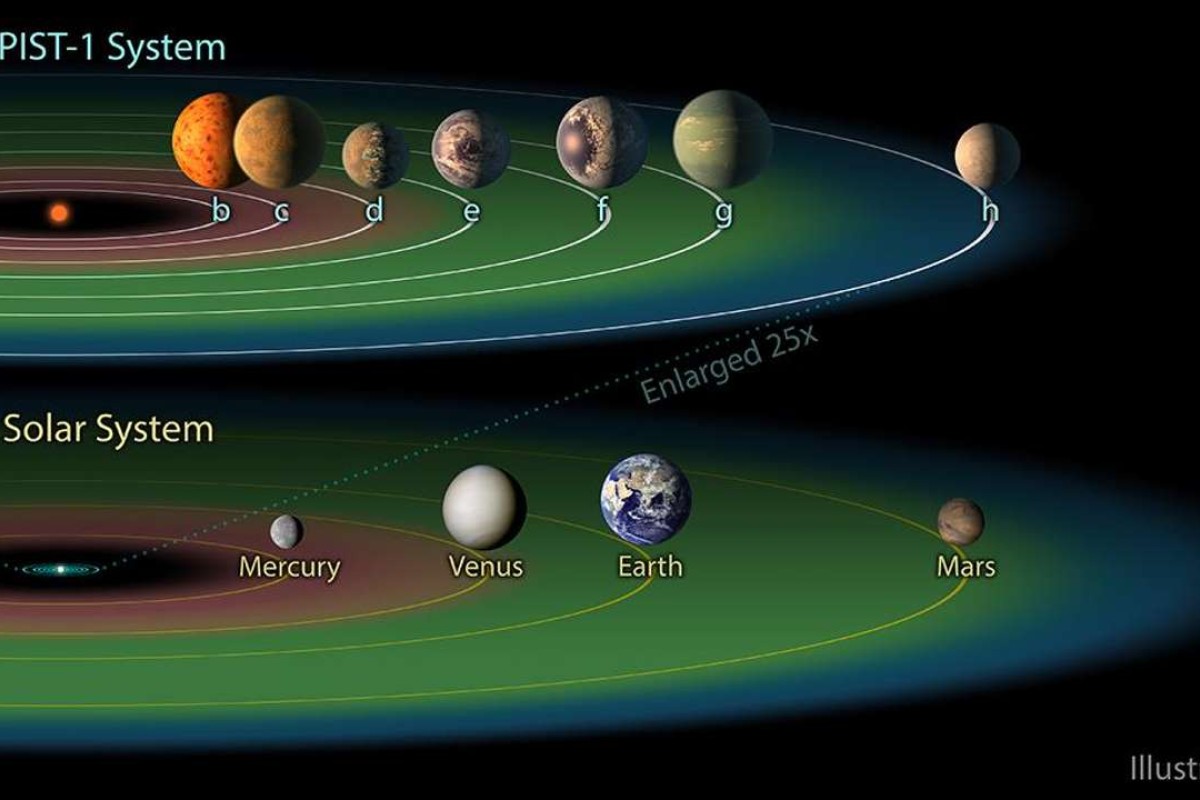
On Wednesday, a Dutch-led international research team using both ground and space-based telescopes announced they’d discovered a solar system 40 light-years away with seven Earth-size planets revolving around a small star.
It’s possible that the innermost three planets have “limited regions” with conditions amenable to liquid water, according to the new study published in the journal Nature. The next three fall more squarely in what astronomers call the habitable zone, where conditions for life, namely temperature and liquid water, are likelier. The seventh planet circling the system’s dim star is probably too cold for liquid water.
These dim stars, or “ultra-cool dwarf stars” in the lingo, have a bright side. They’re weak to begin with, so planets passing between them and us will block a greater percentage of light than they can with much larger and brighter stars. That makes them about 80 times easier to detect than if they orbited a Sun-size star.
The finding expands on the announcement last year of three Earth-size planets orbiting this star, called Trappist–1. The Dutch team led by Michaël Gillon of the Université de Liège has since figured out that one of those three planets is actually three separate planets. Two newly found neighbours bring the Trappist–1 system total to seven, the announcement revealed.