Advertisement
Space
WorldUnited States & Canada

What lies beneath: Nasa’s Juno spacecraft gazes deep inside Jupiter’s swirling interior

Reading Time:2 minutes
Why you can trust SCMP
This NASA image obtained February 18, 2018 shows swirling cloud formations in the northern area of Jupiter's north temperate belt in a new view taken by the Juno spacecraft on February 7. Photo: AFP
Reuters

The interior of Jupiter is just as intriguing as the planet’s dazzling surface, with a swirling mixture of liquid hydrogen and helium at its centre, vast atmospheric jet streams and exotic gravitational properties, scientists said on Wednesday.

Data from Nasa’s Juno spacecraft, orbiting the solar system’s largest planet since 2016, is providing researchers with what they called unprecedented insight into Jupiter’s internal dynamics and structure. Until now, scientists have had scant information about what lies below Jupiter’s thick red, brown, yellow and white clouds.
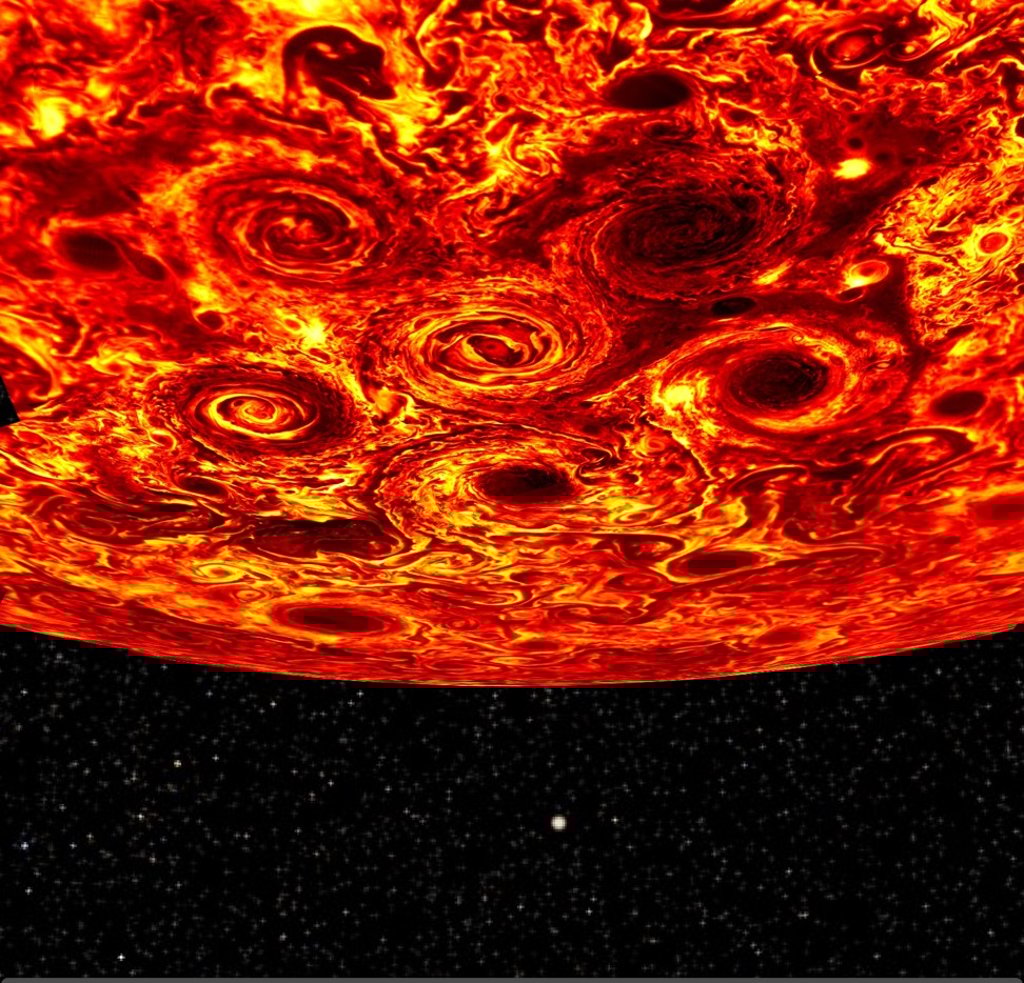
This handout picture provided by Nature and released by NASA/SWRI/JPL/ASI/INAF/IAFPS on March 8, 2018 shows Jupiter's South Pole in a mosaic of images acquired by the Jovian InfraRed Auroral Mapper at wavelengths. Jupiter's tempestuous, gassy atmosphere stretches some 3,000 kilometres (1,860 miles) deep and comprises a hundredth of the planet's mass, studies based on observations by NASA's Juno spacecraft revealed on March 7, 2018. / AFP PHOTO / NASA/SWRI/JPL/ASI/INAF/IAFPS / - / RESTRICTED TO EDITORIAL USE - MANDATORY CREDIT
Advertisement

“Juno is designed to look beneath these clouds,” said planetary science professor Yohai Kaspi of the Weizmann Institute of Science in Israel, who led part of the research using Juno’s new measurements of Jupiter’s gravity.

“On Jupiter, a gaseous planet without a solid surface, we can only gather information from orbit,” added aerospace engineering professor Luciano Iess of Sapienza University of Rome, who also led part of the research.
An illustration depicting the US space agency's Juno spacecraft in orbit above Jupiter's Great Red Spot. Photo: Nasa/JPL-Caltech handout via Reuters
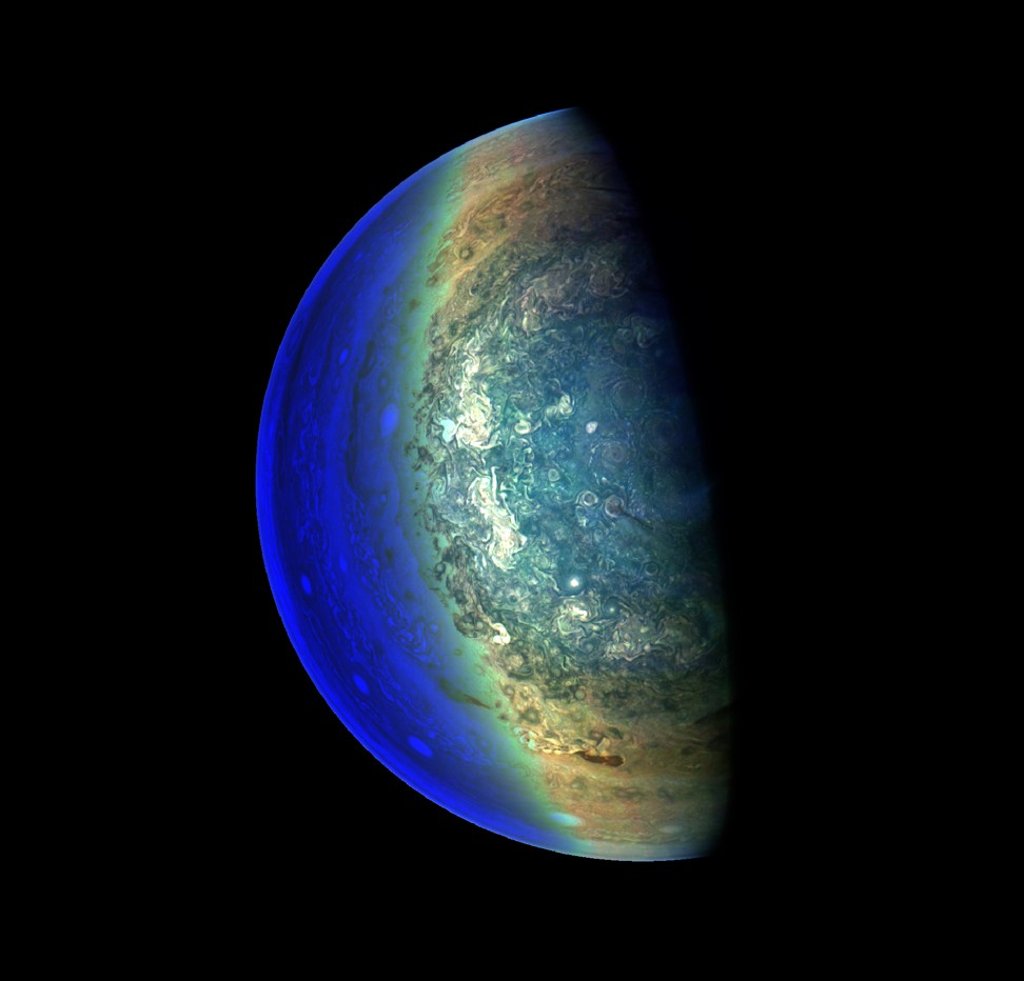
This NASA image released March 2, 2018 captures the swirling cloud formations around the south pole of Jupiteras capturd by the Juno spacecraft in this color-enhanced image taken on February 7. Photo: AFP
Advertisement

Jupiter is a type of planet called a gas giant, as opposed to rocky planets like Earth and Mars, and its composition is 99 per cent hydrogen and helium. Juno’s data showed that as you go deeper under the surface, Jupiter’s gas becomes ionised and eventually turns into a hot, dense metallic liquid.

Advertisement
Select Voice
Choose your listening speed
Get through articles 2x faster
1.25x
250 WPM
Slow
Average
Fast
1.25x