Advertisement
United States
World

‘Huge negative splash’: North Korea says return of US carrier worsens tensions

  • The comments came a day after the USS Ronald Reagan began a new round of naval drills with South Korean warships off the peninsula’s east coast
  • The Reagan returned after North Korea fired a powerful missile over Japan earlier this week to protest the carrier group’s training with South Korea

Reading Time:2 minutes
Why you can trust SCMP
1
USS Ronald Reagan is escorted as it arrives in Busan, South Korea on September 23. North Korea warned on October 8 that the US redeployment of an aircraft carrier near the Korean Peninsula is causing a “considerably huge negative splash” in regional security, as it defended its recent missile tests as a “righteous reaction” to intimidating military drills between its rivals. Photo: AP
Associated Press
North Korea on Saturday warned that the US redeployment of an aircraft carrier near the Korean peninsula is causing a “considerably huge negative splash” in regional security, as it defended its recent missile tests as a “righteous reaction” to intimidating military drills between its rivals.

The North Korean defence ministry statement came a day after the nuclear-powered aircraft carrier USS Ronald Reagan began a new round of naval drills with South Korean warships off the peninsula’s east coast.

The Reagan and its battle group returned to the area after North Korea fired a powerful missile over Japan earlier this week to protest the carrier group’s previous training with South Korea.

The Reagan’s redeployment is “an event of considerably huge negative splash to the regional situation”, a spokesman at the North Korean defence ministry said in remarks carried by state media. “The armed forces of (North Korea) is seriously approaching the extremely worrisome development of the present situation.”

Advertisement

He also called the Reagan’s return “a sort of military bluffing” to issue a warning over North Korea’s “righteous reaction” to “the extremely provocative and threatening joint military drills of the US and South Korea.”

North Korea regards US-South Korean military exercises as an invasion rehearsal and is especially sensitive if such drills involve US strategic assets like an aircraft carrier. North Korea has argued it was forced to pursue a nuclear weapons programme to cope with US nuclear threats. US and South Korean officials have repeatedly said they have no intentions of attacking the North.
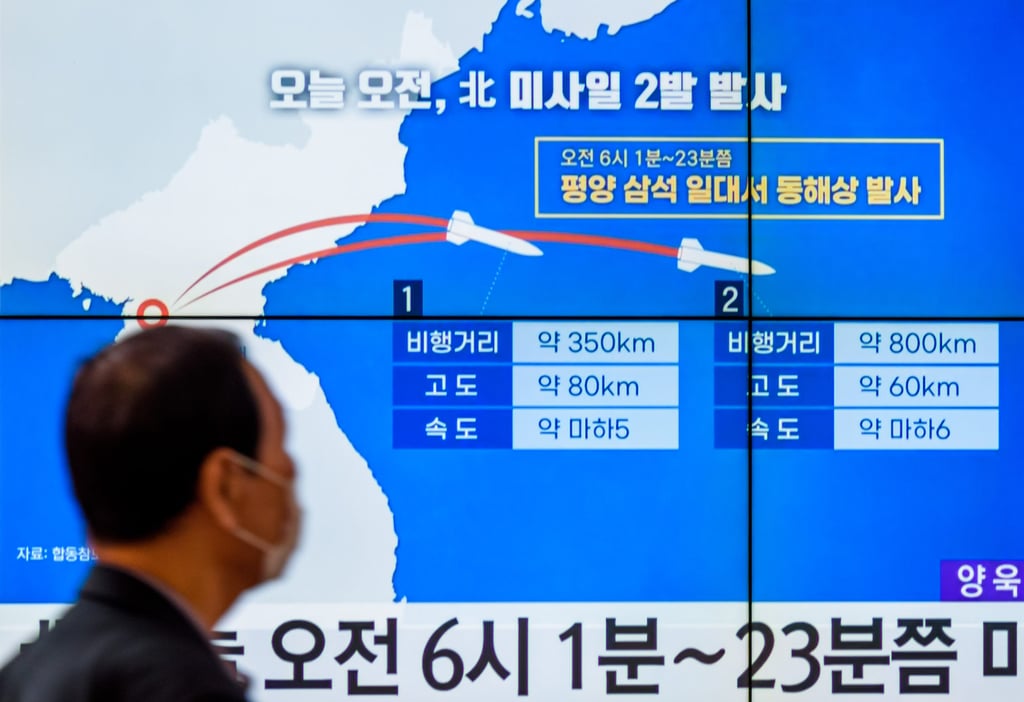
A man looks at a TV screen in Seoul showing news reporting on North Korea’s firing of two short-range ballistic missiles into the East Sea on October 6, the sixth of its kind in just 12 days, in apparent protest of the return of the USS Ronald Reagan aircraft carrier to the East Sea. Photo: dpa
In the past two weeks, North Korea has fired 10 ballistic missiles into the sea in five launch events, adding to its record-breaking pace of weapons tests this year. The recent weapons tests include a nuclear-capable missile that flew over Japan for the first time in five years and showed a range to strike the US Pacific territory of Guam and beyond.
Advertisement
Select Voice
Choose your listening speed
Get through articles 2x faster
1.25x
250 WPM
Slow
Average
Fast
1.25x