Nasa spacecraft blasts off for Jupiter’s moon Europa in search of life
After a journey of nearly 3 billion kilometres, Europa Clipper is expected to arrive in Jupiter’s orbit in 2030

Nasa launched a spacecraft from Florida on Monday on a mission to examine whether Jupiter’s moon Europa has conditions suitable to support life, with a focus on the large subsurface ocean believed to be lurking beneath its thick outer shell of ice.
It is the largest spacecraft Nasa has built for a planetary mission, at about 30.5 metres (100 feet) long and about 17.5 metres wide with its antennas and solar arrays fully deployed – bigger than a basketball court – while weighing around 6,000kg (13,000 pounds).
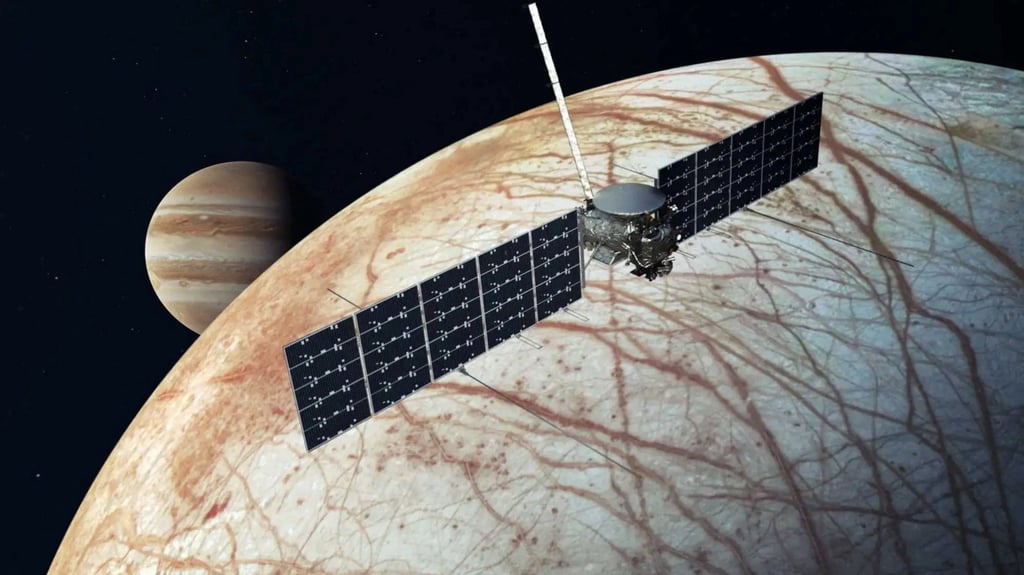
Even though Europa, the fourth-largest of Jupiter’s 95 officially recognised moons, is just a quarter of Earth’s diameter, its vast global ocean of salty liquid water may contain twice the water in Earth’s oceans. Earth’s oceans are thought to have been the birthplace for life on our planet.