
Advertisement
North Korea
Opinion
Shi Jiangtao

My Take | Beijing’s nearest security threat isn’t in Taipei – it’s in North Korea

  • Compared to the pragmatic tone from Taiwan’s new leader, North Korea’s Kim Jong-un presents a far more potent security threat for Beijing
  • With Russia’s help, Kim poses a bigger danger to China and the world than William Lai

Reading Time:4 minutes
Why you can trust SCMP
13
North Korean leader Kim Jong-un visits a defence industrial complex at an undisclosed location in North Korea on May 17. US intelligence has suggested a possible election-year provocation from Pyongyang to “create turmoil … possibly at the urging of Russian President Vladimir Putin”. Photo: AFP/KCNA via KNS
Not surprisingly, Beijing reacted strongly last week to the inauguration of new Taiwanese leader William Lai Ching-te, launching one of the biggest military drills in years, including a simulated blockade of the island.

Such a furious response was, in a large part, well anticipated. Beijing has made no secret of its disdain for Lai, portraying him as a “dangerous separatist” and his presidential election victory in January as a grave challenge to its desire for reunification.

03:03

Furious mainland China slams Taiwanese leader’s ‘blatant’ call for independence

Furious mainland China slams Taiwanese leader’s ‘blatant’ call for independence

It is understandable that Beijing feels anxious about the self-ruled island’s new leader, who, compared to his predecessor Tsai Ing-wen, appears more vocal about the issue of independence, a matter the Communist Party sees as a “red line”.

Advertisement
Despite intensified intimidation tactics by mainland China, Lai last week in his inauguration speech described Taiwan as “a sovereign, independent nation” and said Beijing and Taipei “are not subordinate to each other”.

For Beijing, those words may sound more provocative than what Lai has said in the past, including an assertion that there is no need to declare formal independence because Taiwan is a de facto independent state.
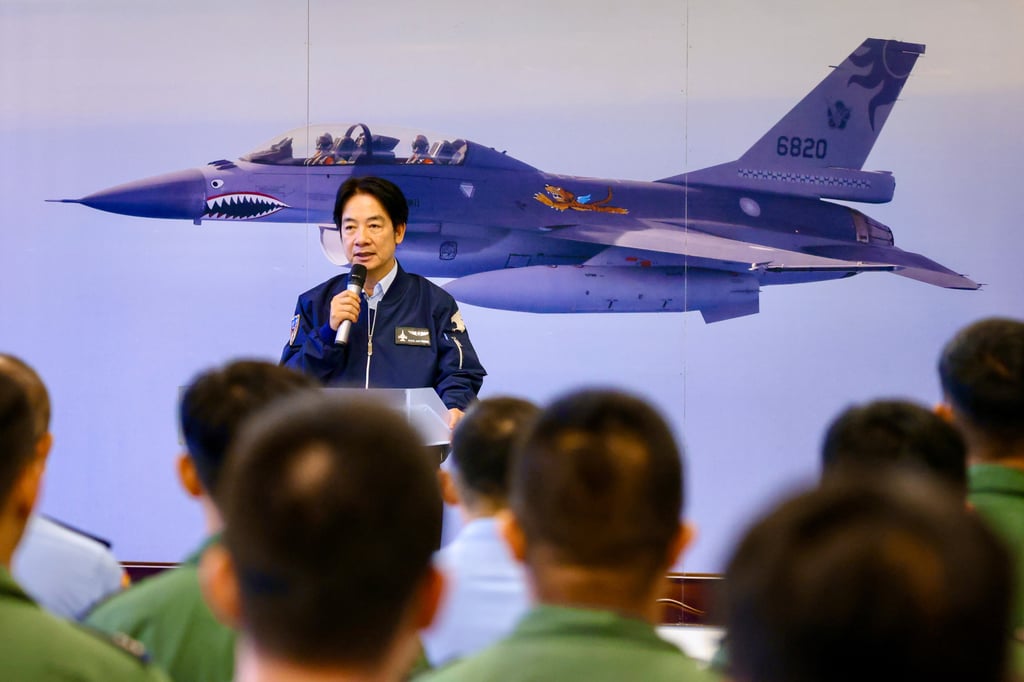
Taiwanese leader William Lai Ching-te speaks to military personnel during a visit to an air base in Hualien on Monday. Photo: EPA-EFE

But flexing military muscles over Taiwan amid heightened tensions in the South China Sea between Beijing and Manila could push China’s fragile detente with the United States to the breaking point and raise the spectre of an unwanted armed conflict.

Advertisement
Select Voice
Choose your listening speed
Get through articles 2x faster
1.25x
250 WPM
Slow
Average
Fast
1.25x