
Advertisement
Diplomacy
OpinionAsia Opinion
Opinion
C. Uday Bhaskar

What does US Pacific Command name change mean for China and India?

Reverting to the long-used name reflects a more traditional maritime focus while prioritising deterring China, as the Quad loses relevance

3-MIN READ3-MIN
Listen
From the left, a Royal Australian Air Force F-35A, a US Air Force F-35A Lightning II, a Japan Air Self-Defence Force F-35A, and a US Marine Corps F-35B Lightning II fly over the US Pacific Command area of responsibility during exercise Cope North on February 7. Photo: US Air Force
Commodore C. Uday Bhaskar is director of the Society for Policy Studies (SPS), an independent think tank based in New Delhi.
In a layered signal to Indo-Pacific nations and America’s domestic audience, the Trump administration last week said the US Indo-Pacific Command would revert to its long-used name, the US Pacific Command. The Honolulu-headquartered command was renamed in 2018 during Donald Trump’s first presidency.
The administrative order by the Department of Defence was justified to honour the legacy of America’s oldest and largest unified combatant command, established in 1947. In the run-up to the 250th anniversary of US independence on July 4, the Trump administration is kindling patriotic fervour as part of the Make America Great Again agenda.

While the name change suggests that the command will return to a more traditional focus on the Western Pacific and a priority of deterring China, Pentagon officials have stressed that any operational impact would be negligible.

Advertisement

The command’s vast area of responsibility remains unchanged. It spans roughly 52 per cent of the Earth’s surface, stretching from the US west coast to the western maritime boundary of India in what was once described as from Hollywood to Bollywood. Also unchanged is the command’s mission, which includes maintaining credible power, protecting US interests throughout the Indo-Pacific and enhancing US alliances and partnerships.

The Taiwan challenge looms large on the Honolulu radar and in a recent US Congress testimony, Admiral Samuel Paparo – who heads the command – highlighted Beijing’s growing threat, particularly risks around Taiwan, and urged continued investment.
Advertisement

The US$122 billion package he requested for the 2026-27 financial year covering new military inventory, related systems and logistic support was described as “the minimum investments required to sustain credible deterrence and prevail in conflict if deterrence fails”.
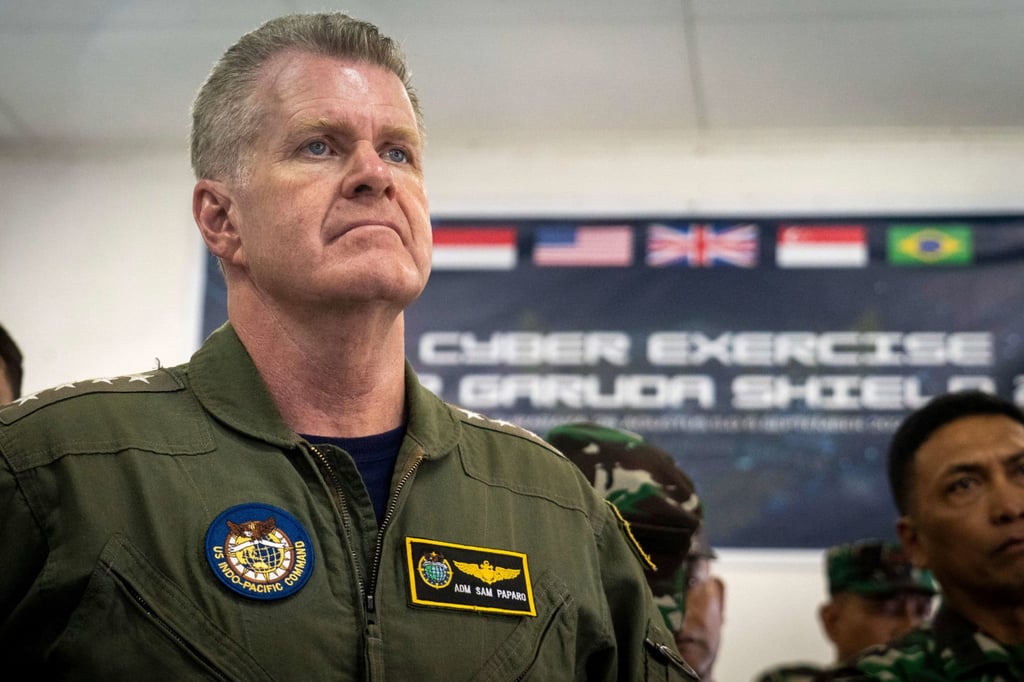
US Navy Admiral Samuel J. Paparo, commander of the then-named US Indo-Pacific Command, observes a cyber exercise as part of Super Garuda Shield on August 31, 2024, in Surabaya, Indonesia. Photo: Handout
Advertisement
Select Voice
Select Speed
1.00x