Advertisement
Yuan
OpinionChina Opinion
Opinion
Tan Poh Hwee

Markets, not politics, will make China’s yuan a global currency

Until authorities can reduce costs and allay the market’s concerns, yuan internationalisation will be stronger on paper than balance sheets

3-MIN READ3-MIN
1
Listen
Bundles of 100 yuan notes at a bank in Shanghai. China’s latest five-year plan includes having Hong Kong play an increased role as an offshore yuan hub. Photo: AFP
Tan Poh Hwee is president of the Asia Academy of Digital Economics, a Singapore-based non-profit, and a corresponding fellow of the National Academy of Artificial Intelligence.
The yuan’s next global push will fall short if it is treated as persuasion. The test is not whether Beijing wants an international currency or whether Hong Kong can host summits around it. It is whether a treasurer in Jakarta, a bank in Riyadh or a Gulf central bank can fund, hedge, invest and exit yuan positions at a predictable cost. Until then, yuan internationalisation will look stronger in policy papers than on balance sheets.
Hong Kong Monetary Authority (HKMA) Chief Executive Eddie Yue Wai-man is right to put yuan internationalisation at the centre of Hong Kong’s financial agenda and to highlight liquidity and direct conversion costs. These are not technical details. They are the language of market doubt, asking why the yuan can be used to settle invoices yet still be avoided in financing, reserves and risk management.

The progress is real, but so are the limits. Hong Kong’s yuan deposits reached 1.13 trillion yuan (US$166.3 billion) at the end of May, with monthly cross-border trade settlement remittances above 1.12 trillion yuan. In May, however, the yuan accounted for only 2.75 per cent of global payments by value on the Swift international payment system, while the US dollar took 50.73 per cent.

In trade finance, the yuan’s 7 per cent share looked stronger, but the US dollar still commanded 82.5 per cent. International Monetary Fund data put the yuan at just 1.99 per cent of global foreign exchange reserves in the first quarter. The yuan is growing, but it is not yet indispensable.

Settlement is not currency power. A true international currency finances projects, backs collateral, anchors hedging markets and sits in reserves without unnerving investors. The yuan has entered the first category, but it is still fighting for the second.

The problem begins with offshore liquidity. A company can receive yuan, but it must also borrow it, roll it over and hedge it when markets tighten. If offshore yuan funding becomes unstable or more expensive than US dollar funding, corporate loyalty disappears. Treasurers do not make geopolitical statements with working capital – they choose the cheapest reliable instrument.
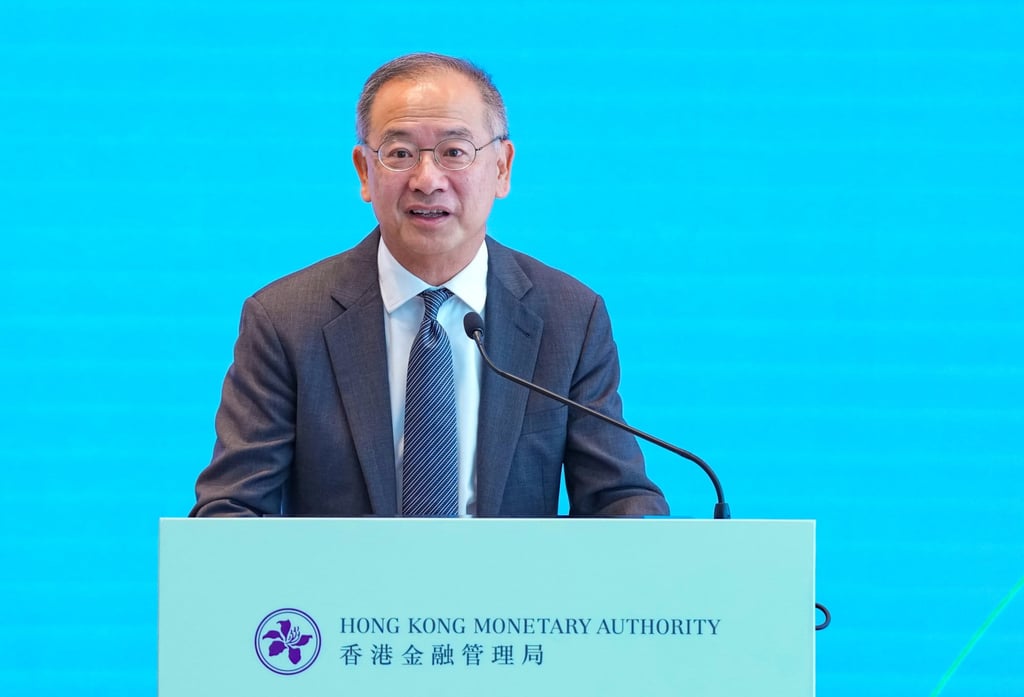
Hong Kong Monetary Authority Chief Executive Eddie Yue Wai-man delivers a speech at the International Finance Centre in Central on November 12, 2025. Photo: Karma Lo
Advertisement
Select Voice
Select Speed
1.00x