Lani Cupchoy, PhD, is based in Los Angeles, California, and is co-author of Echoes of Memory: War, Testimony and Survival on Sanzao Island.
During Ching Ming Festival this year, I travelled to China for the first time and my family gathered on Sanzao Island in the Pearl River Delta to honour our ancestors. On a spring morning, as relatives offered incense and arranged paper offerings before the ancestral graves and thin streams of smoke drifted into the warm coastal air, I was at long last standing on the island my family had spoken about for generations.
My great-grandfather had left Sanzao as a sojourner in the late 19th century and eventually built a life across the Pacific, in Maui, with my great-grandmother, a native Hawaiian Chinese. Like many migrants of his generation, my great-grandfather carried his future abroad while leaving parts of his life behind – including a frail, handwritten manuscript dating back to the twilight of the Qing dynasty. Unexpectedly, this was still waiting for me during my trip, having been preserved over generations and donated to the Zhuhai Museum.
His journey was part of a broader history linking China to Hawaii, where Chinese migrants formed families across cultures, shaping communities that bridged ocean and origin.
For me, Sanzao existed first through memory: stories passed down, photographs and other fragments carried across distance, names of places I had never set foot in. For two decades, my father, Robert Cupchoy, travelled to Sanzao to listen to elders and record their memories of the Japanese occupation. As I worked with him on what would eventually become our book, Echoes of Memory: War, Testimony and Survival on Sanzao Island, I came to know the island before I ever saw it myself.
Returning to our ancestral homeland during Ching Ming, not only as a descendant but also as a co-author, gave my journey particular weight. The festival is a time of remembrance and for many in the Chinese diaspora, a chance for a homecoming of sorts.
My cousins, Yingxiu Chen and Jianming Chen, welcomed me and accompanied me as I retraced my family’s history across the island. Through them, I was able to see places such as the home built by my great-grandfather. And in the Zhuhai Museum, I held in my hands the yellowing slim volume he had filled with his thoughts as a young man in 1877. Reading his observations of daily life and poetic reflections on the natural scenery around Sanzao created a sense of connection across time.
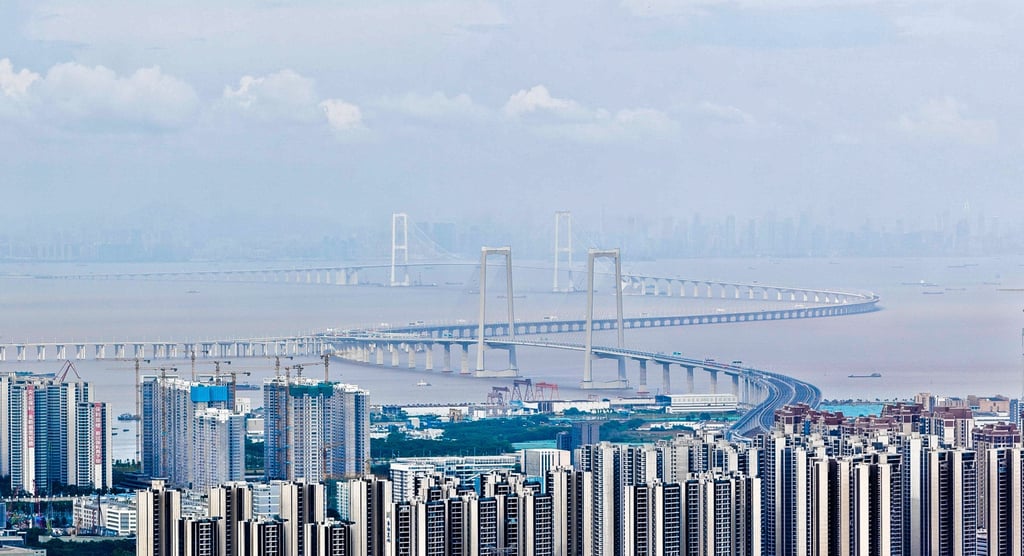
The Shenzhen-Zhongshan Link in Guangdong province. It is one of the bridges connecting cities in the Pearl River Delta that are on opposite sides of the Pearl River estuary. Photo: Xinhua