What best sums up local culture? Some mainstays are so taken for granted that they only become properly appreciated, valued and nurtured during times of uncertainty.
From the beginning, an emergent local Hong Kong culture – quite distinct from anything found elsewhere in southern China – imported, adapted, then embraced an assortment of influences from across the world.
Readily consumable, cliché examples abound. Crusty egg tarts from backstreet bakeries recall only faint traces of their European (or more specifically, Portuguese) ingredients. Likewise, Hong Kong-style milk tea – made with tannin-rich tea dust and condensed milk – betrays its Indian bazaar origins, having been introduced here via the British forces, and preparation methods gradually spread across the territory through skills learned in military cookhouses and NAAFI (Navy, Army and Air Force Institutes) canteens.
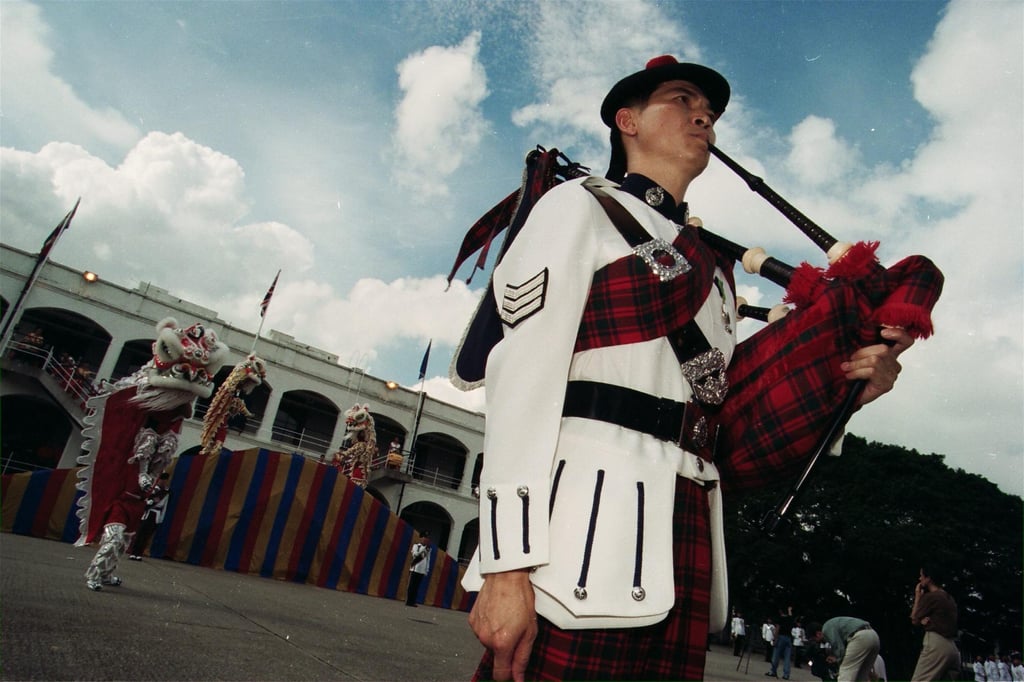
Sergeant Edward Lam Yat-sing of the Royal Hong Kong Police Force Band wears the Mackintosh tartan for a rehearsal. Photo: SCMP
But when asked which musical style has become elementally “Hong Kong”, most people would probably note Cantopop, along with concert icons such as the Four Heavenly Kings, and perhaps make a passing reference to earlier local bands such as The Mystics. While reasonable enough, these guesses overlook the most widespread, “gone local” musical introduction of all, one that can be heard plaintively wailing in a performance or a practice session somewhere in Hong Kong throughout the year. Yes, you guessed correctly: the Scottish bagpipes.
Bagpipes were introduced into maritime Asia in the late 16th century, with the first permanent settlers from Scotland. Lured out East by better economic opportunities as Scotland steadily stagnated, these homesick Scots-in-exile would do anything for their beautiful country, except actually live in it. By the mid-18th century, large, well-established Scottish communities existed in prosperous commercial cities from Calcutta to Canton. Along with a shrewd business sense, the Scots exported their own distinctive cultural life. No community gathering, especially the annual Burns Night binge, was complete without bagpipers.
Egalitarian-minded Scots were happy to share their musical skills with fresh enthusiasts and, over time, these strange-looking, distinctive-sounding, technically complex wind instruments became widespread among non-Scottish populations. In pre-independence India, bagpipes became commonplace ceremonial components in military bands, and remain a much-enjoyed tradition in garrison life in modern India and Pakistan.
From the late 19th century, Hong Kong police bands prominently featured bagpipers, and still do. Other local disciplined services units have also incorporated the instrument. Bagpipes are traditionally draped with tartan cloth. Distinctive, colourful patterns immediately signified the piper’s clan or, less usually, a sponsor.